

In the early days of SEO, a guest post was just a vehicle for a backlink. You could spin 500 words of generic advice, drop a keyword-rich anchor text, and watch your rankings climb.
That era is officially over.
As we navigate 2026, Google’s AI-driven algorithms powered by the Helpful Content System and E-E-A-T—have become incredibly sophisticated at sniffing out “SEO filler.” Today, a low-quality guest post doesn’t just fail to help; it can actually trigger a site-wide “unhelpful content” signal.
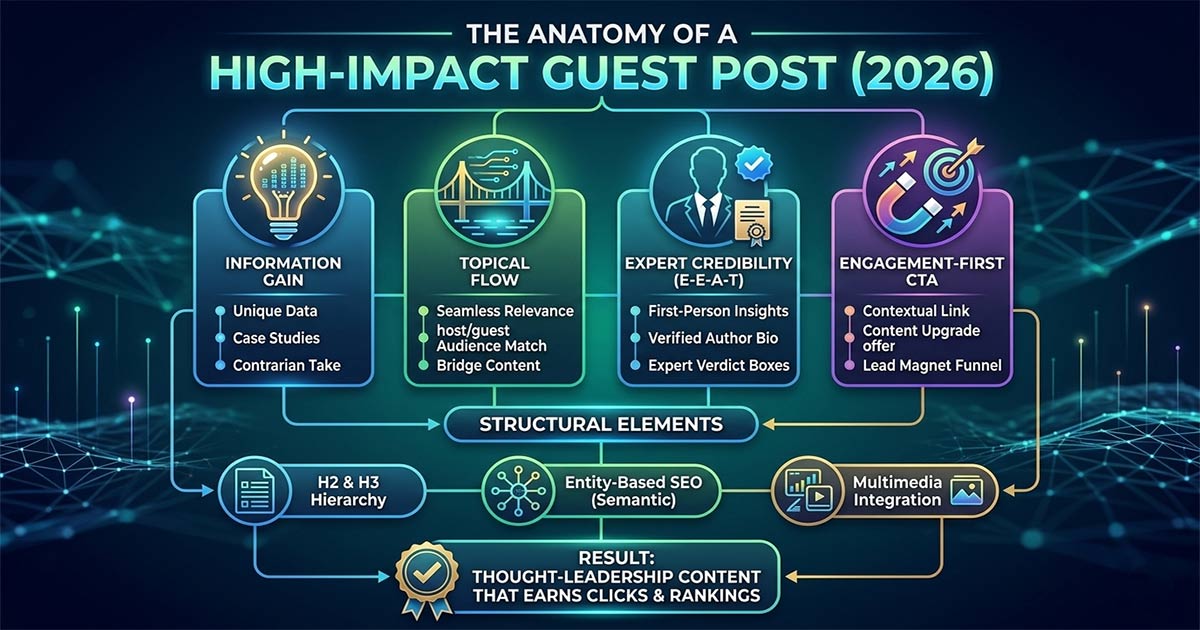
To rank in 2026, you must move from link-building to Authority-Building. Here is the anatomy of a high-impact guest post that earns both clicks and rankings.
1. The “Information Gain” Threshold
Google’s recent patents and updates emphasize Information Gain. If your guest post simply repeats what is already in the top 10 search results, it has zero value.
- The Anatomy Fix: Every post must include a unique data point, a personal case study, or a “contrarian” take on an industry standard.
- The Goal: Give the search engine a reason to index your guest post alongside existing content rather than ignoring it as a duplicate.
2. Radical Relevance & Topical Flow
In 2026, the “neighborhood” of your link matters more than the link itself. A high-impact post must have a seamless “Topical Flow.”
- The Anatomy Fix: The guest post topic must be a perfect bridge between the host site’s audience and your service. If you are a Fintech company guest posting on a Tech blog, don’t just write about “Money.” Write about “How API-First Banking is Disrupting SaaS Subscriptions.”
- The Result: This creates a natural path for Referral Traffic, which is a massive credibility signal to Google.
3. Proof of Expertise (The “E” in E-E-A-T)
Anonymous or “Ghostwritten” content is losing its power. Google wants to see that a human with real-world experience wrote the piece.
- The Anatomy Fix: Use first-person phrasing (“In my experience,” “Our team tested…”). Ensure the author bio links to a verified LinkedIn profile or a robust “About” page.
- Pro Tip: Include a “Key Takeaway” box or a “Expert Verdict” section to break up the text and highlight high-value insights.
4. Semantic Optimization (Beyond Keywords)
Keyword stuffing is dead; Entity-based SEO is alive. Search engines now look for “Entities” (concepts, brands, and people) and their relationships.
- The Anatomy Fix: Use Latent Semantic Indexing (LSI) keywords and satisfy multiple search intents. If the primary keyword is “Backlink Building,” your post should naturally include entities like “Digital PR,” “Link Decay,” “Citations,” and “Topical Authority.”
- Structure: Use H2 and H3 tags to create a logical hierarchy that AI crawlers can parse in milliseconds.
5. The “Engagement-First” CTA
A high-impact guest post isn’t a dead end. It should be the start of a funnel.
- The Anatomy Fix: Instead of a generic “Visit our site” link, use a Contextual Call-to-Action.
- Example: “If you’re struggling to audit your own site for these signals, our 2026 Link Health Template can help you spot these red flags in minutes.”
The 2026 Guest Post Checklist
Before you hit “Send” on your next pitch, ensure your post meets these criteria:
- Zero AI-Hallucinations: Fact-check every claim.
- Multimedia Integration: Includes at least one original chart, screenshot, or video embed.
- Mobile-First Formatting: Short paragraphs (2-3 sentences), bullet points, and bolded text for skimmability.
- Deep Linking: Links to other high-authority resources, not just your own site.

Frequently Asked Questions (FAQ)
Q1: What is “Information Gain” in guest posting?
Information Gain is an SEO concept where Google rewards content that provides unique value or new data not found in other top-ranking articles. In 2026, simply paraphrasing existing content is no longer enough; your guest post must offer a fresh perspective, original case study, or unique insight to rank well.
Q2: Why is “Topical Flow” important for backlinks?
Topical Flow ensures that the link between the host site and your website feels natural and relevant to the reader. Search engines now prioritize the context of a link. If the transition between the article’s topic and your linked service is seamless, it passes more authority and is more likely to drive high-quality referral traffic.
Q3: How do I demonstrate E-E-A-T in a guest post?
To satisfy E-E-A-T (Experience, Expertise, Authoritativeness, and Trustworthiness), you should use a verified author with a real bio, include first-hand experiences or “Expert Verdict” sections, and link to credible third-party sources. This proves to both Google and the reader that the content was created by a human expert rather than generated by generic AI.