
The SEO landscape of 2026 has officially moved past the “blue links” era. With the mass adoption of Search Generative Experience (SGE) and AI-led discovery, the role of the backlink has undergone a fundamental transformation.
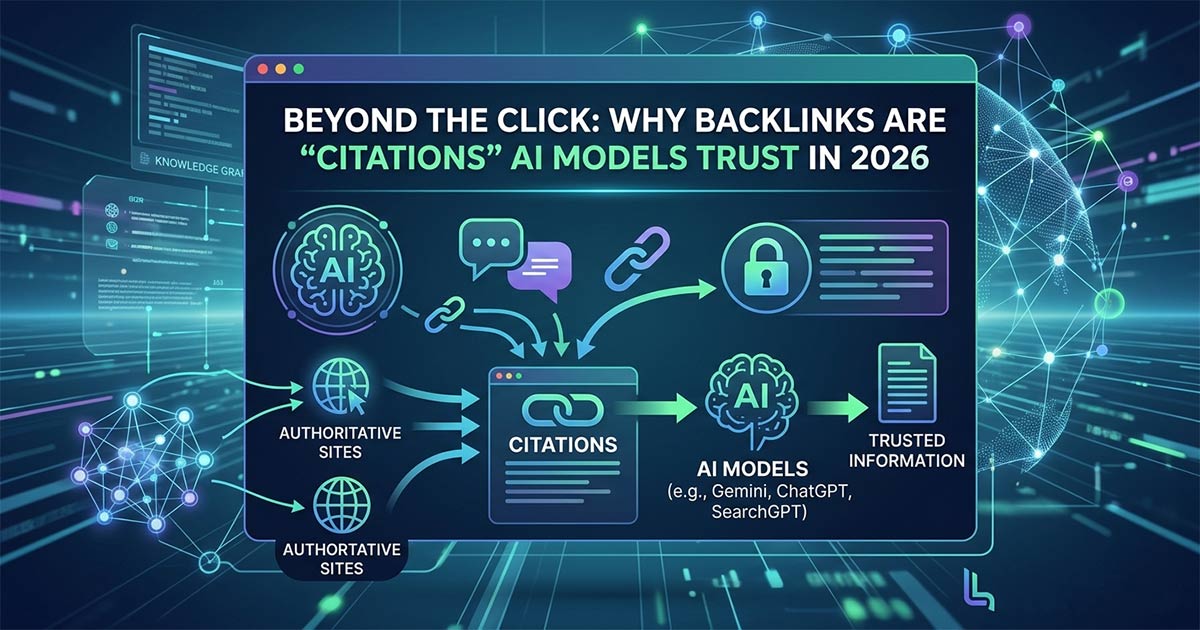
If you are still building links just to boost a “Domain Authority” score, you are playing a 2020 game in a 2026 world. Today, Google’s Gemini, OpenAI’s SearchGPT, and Perplexity don’t just look at links as votes of popularity they treat them as scholarly citations.
Here is why backlinks are the “trust signals” that anchor the future of AI-driven search.
1. From “Link Juice” to “Fact Verification”
In traditional SEO, a link was a pipe that transferred “link juice” (PageRank) from one site to another. In 2026, AI models use links to verify the truth.
When an AI model generates an answer, it cross-references multiple high-authority sources to ensure accuracy. If your website is consistently linked by reputable, niche-specific platforms, the AI views your content as a verified fact. * The Shift: It’s no longer about how many links you have; it’s about how many “Truth Anchors” point to your data.
- The Result: A single link from a peer-reviewed industry site is now more valuable than fifty generic guest posts.
2. Backlinks as “Training Data” for LLMs
Large Language Models (LLMs) like Gemini and ChatGPT are trained on the vast web. During their crawling and “reasoning” phases, these models identify patterns of authority.
When high-authority sites link to you, they are effectively telling the AI’s neural network: “This entity is a primary source for this topic.” This influences how the AI “remembers” your brand when a user asks a conversational prompt like, “Who are the best link-building experts in India?”
3. The Rise of “Niche Relevancy” over “Big Metrics”
In 2026, a high DR (Domain Rating) is a vanity metric if the relevance isn’t there. AI models are masters of context. They understand the “semantic distance” between the linking site and the target site.
- 2020 Logic: Get a link from a big news site (even if it’s about tech and you sell gardening tools).
- 2026 Logic: Get a link from a specialized gardening blog. The AI sees this as a contextual citation, reinforcing your expertise in a specific “Knowledge Graph.”
4. Attributing the “Source of Truth” in AI Overviews
Have you noticed the small carousel of links at the top of AI search results? Those aren’t just random suggestions. They are the citations the AI used to build its answer.
To appear in these coveted AI Overviews (GEO – Generative Engine Optimization), your backlink profile must prove that you are an authority. AI models are programmed to cite the most “trusted” sources to avoid hallucinations. If you aren’t being cited by others, the AI won’t cite you to the user.
How to Build “Citation-Grade” Backlinks in 2026:
- Prioritize Primary Research: Publish original data, surveys, or case studies. These are the most “citeable” forms of content.
- Focus on Digital PR: Aim for mentions in publications that AI models recognize as authoritative “Seed Sites.”
- Audit for “Toxic” Patterns: AI is much better at spotting manipulative link schemes than old algorithms. If it looks like a “link farm,” the AI will ignore it or worse, flag your entity as untrustworthy.
- Strengthen Your Entity: Ensure your “About Us,” “Author Bios,” and LinkedIn profiles align with the content you are publishing. Backlinks link pages, but citations validate entities.
The Bottom Line
In 2026, the click is just the beginning. The real value of a backlink lies in its ability to act as a digital fingerprint of trust. As AI continues to mediate how we find information, your goal is to ensure that when the “brain” of the internet looks for an answer, all roads and all citations lead to you.
Is your backlink profile ready for the AI era? Would you like me to analyze your current top-performing pages to see if they are structured as “citeable” content for AI models? Consult LinqBuilder here.
FAQs’
Q1: Do backlinks still matter for AI search engines?
Absolutely. In 2026, AI models like Gemini and ChatGPT use backlinks as “citations” to verify the accuracy of the information they provide. High-quality links act as a trust signal that prevents the AI from “hallucinating” your brand’s data.
Q2: What is Generative Engine Optimization (GEO)?
GEO is the evolution of SEO. It focuses on optimizing content so that AI models can easily find, cite, and include your website in their generated responses or “AI Overviews.”
Q3: How do I get my website cited in AI Overviews?
To be cited, you need to provide “source of truth” content, such as original research, expert opinions, or detailed case studies, backed by a strong profile of niche-relevant backlinks.