


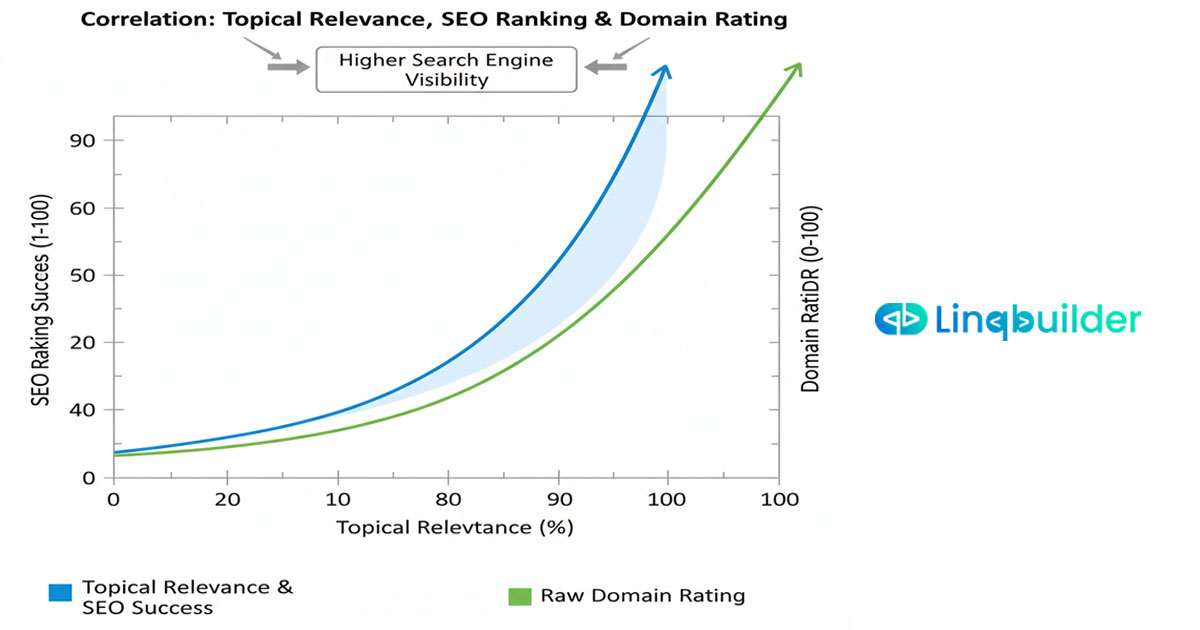
For high-growth websites, a Domain Rating (DR) of 90+ is often seen as the “Holy Grail” of SEO. But in 2026, chasing raw metrics without considering topical relevance has become one of the fastest ways to trigger a ranking suppression.
At Linqbuilder.com, we call this the “DR 90 Trap.” It’s the dangerous assumption that a link from a massive site like a national news outlet or a generic high-authority blog is always better than a link from a niche specialist.
Here is the mathematical and algorithmic reality of why “big” isn’t always “better” for your SEO.
The “DR 90” Trap: Why High Authority Links Can Sometimes Tank Your Rankings
In the early days of SEO, a link was a link. If you got a backlink from a DR 90 site, your rankings went up. Period. But as we move further into 2026, Google’s Entity-Based Search and Topical Authority algorithms have matured.
Today, Google doesn’t just ask, “Is this site authoritative?” It asks, “Does this site have any business talking about this topic?”
If the answer is no, that expensive high-DR link could actually dilute your site’s topical relevance, leading to a sudden drop in rankings a phenomenon known as topical mismatch.
What is the DR 90 Trap?
The DR 90 Trap occurs when an SEO acquires a backlink from a very high-authority site that has zero topical overlap with their own niche.
The Footprint Problem
Google’s 2026 SpamBrain AI is designed to look for “unnatural footprints.” If your link profile consists of 50 links from hyper-relevant industry blogs and then suddenly spikes with 5 links from a high-DR “General News” site that also sells links to gambling, crypto, and fashion sites, your site is flagged.
This creates an “out-of-niche” footprint that signals manipulation rather than genuine editorial merit.
Why Irrelevant Authority Kills Your E-E-A-T
Google’s E-E-A-T (Experience, Expertise, Authoritativeness, and Trustworthiness) framework is now measured at the Entity level.
When a DR 90 site with no medical expertise links to your “Health & Wellness” blog, it doesn’t transfer “Health Authority.” Instead, it creates a “Noise Signal.”
- Topical Dilution: If too much of your “link juice” comes from irrelevant sources, Google becomes “confused” about what your site is actually about.
- The Proportional Devaluation: Google’s latest updates include proportional devaluation, where the algorithm simply “ignores” links it deems contextually irrelevant. You spend $1,000 on a link that has a $0 impact on your rankings.
The Math of Relevance: Why DR 30 > DR 90
In 2026, the value of a link is a product of Authority × Relevance.
Link Value = Authority(DR) * Relevance Score (0-1)
Consider these two scenarios:
- Site A (The Trap): A DR 90 General News site with a Relevance Score of 0.1.
- 90 * 0.1 = 9
- Site B (The Winner): A DR 40 Niche-Specific Blog with a Relevance Score of 0.9.
- 40 * 0.9 = 36
Mathematically, the “smaller” link is 4x more valuable because it reinforces your topical authority instead of just inflating a third-party metric.
3 Red Flags of a “Dangerously High” DR Link
Before you invest in a high-DR placement, check for these three red flags:
1. The “Kitchen Sink” Sidebar
Look at the site’s recent outbound links. If they are linking to a dog trainer, a divorce lawyer, and a casino on the same page (or even the same domain), it’s a link farm in high-DR clothing.
2. No Ranking Keywords in Your Niche
Plug the DR 90 site into Ahrefs. Does it rank for any keywords related to your business? If you’re a SaaS company and the site only ranks for “celebrity net worth” and “daily horoscopes,” a link from them will offer zero semantic value.
3. Missing Editorial Guardrails
Does the site have a clear editorial policy, or does it look like anyone can buy a post for the right price? Google’s AI is now excellent at detecting “Paid Guest Post” patterns based on the formatting, length, and placement of the content.
How to Scale Authority Safely (The Linqbuilder Strategy)
At Linqbuilder.com, we don’t just chase DR. We focus on Authority Stacking within your Niche.
- Identify Niche Peers: We target sites that your competitors’ customers actually read.
- Contextual Co-Occurrence: We ensure your link is surrounded by industry-specific terminology that reinforces your entity’s data in the Knowledge Graph.
- Traffic Over Metrics: We prioritize links from sites with actual organic traffic in your niche. If people aren’t clicking, Google isn’t counting.
Conclusion: Don’t Trade Relevance for Vanity
A DR 90 link looks great on an SEO report, but it doesn’t always look great to Google’s algorithm. In 2026, relevance is the only true currency of authority. Stop falling for the DR 90 trap. Focus on building a “tight” link profile that proves you are an expert in your specific field.
Ready to build links that actually move the needle?
Explore Linqbuilder’s Niche-Verified Services and discover high-authority placements that are topically aligned with your brand.
FAQs
Q: Can a high-authority backlink actually hurt my SEO?
A: Yes. If a link comes from a high-DR site that is topically irrelevant or part of a known link farm, it can trigger an “unnatural footprint” flag. This signals manipulation to Google and can lead to a devaluation of your link profile or a ranking drop.
Q: What is more important: Domain Rating or Topical Relevance?
A: In 2026, topical relevance is the primary factor. A link from a relevant site with a moderate DR (30-50) is significantly more effective at boosting your rankings than an irrelevant link from a DR 90+ site.
Q: Does every high-DR link need to be in my exact niche?
A: While 70-80% of your links should be niche-relevant, a few “General” high-DR links (like major news outlets) are healthy for a natural profile. The danger only arises when your profile is dominated by irrelevant, low-quality high-DR sites.