


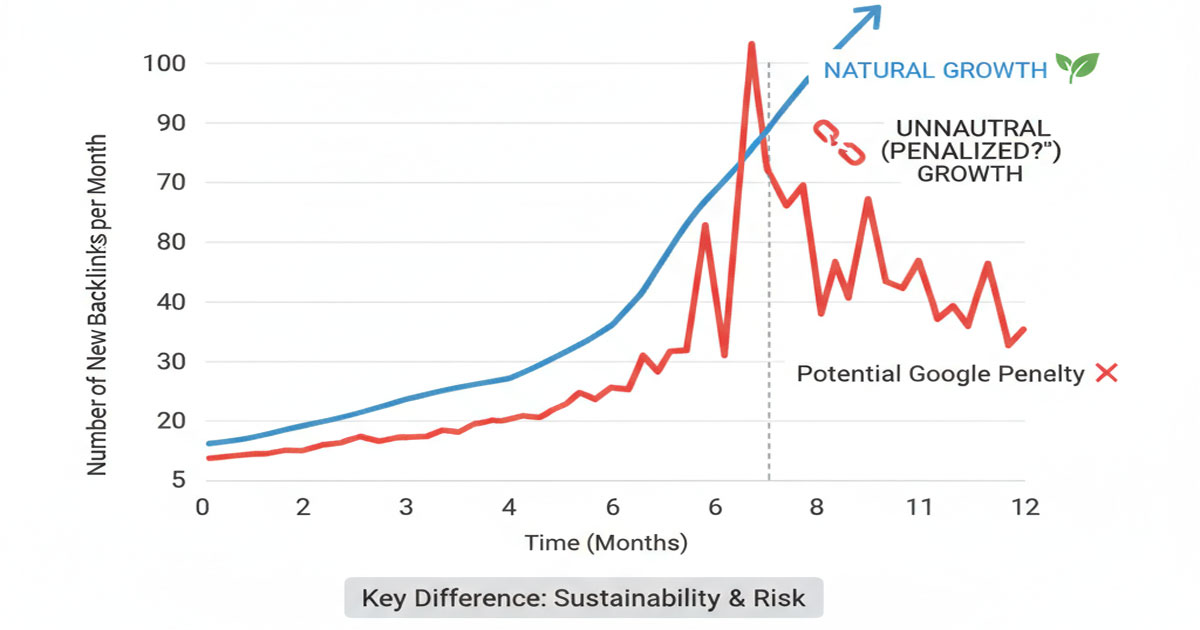
The Mathematics of Link Velocity: How Much is Too Much?
In the high-stakes world of SEO, speed is often equated with success. We want faster load times, faster indexing, and faster rankings. But when it comes to link acquisition strategies, moving too fast can be just as dangerous as moving too slow.
This is the concept of Link Velocity the mathematical rate at which your website earns (or loses) backlinks over a specific period.
If you’ve ever wondered, “How many backlinks per month is safe for a new website?” or “Can I trigger a Google penalty by building links too quickly?” this guide is for you. We’re breaking down the formulas, the risks, and the “sweet spot” for sustainable organic growth in 2026.
What is Link Velocity? (The Formula)
At its core, link velocity is a simple measure of momentum. While most SEO tools like Ahrefs or SEMrush provide visual graphs of this, the manual calculation is:
Link Velocity = Total New Backlinks / Time Period (Days/Months)
Positive vs. Negative Link Velocity
- Positive Link Velocity: You are gaining links faster than you are losing them. This signals to search engines that your content is fresh, relevant, and “trending.”
- Negative Link Velocity: You are losing “link juice” faster than you are acquiring it. This often happens after a PR spike dies down or if you previously engaged in low-quality link schemes where links are now being deleted or de-indexed.
The “Natural Growth” Theory: How Google Views Speed
Google’s algorithms are designed to mimic human interest. In a natural ecosystem, a website doesn’t go from 0 to 500 high-authority backlinks overnight unless something extraordinary happens (like a viral news story or a massive product launch).
If your link velocity looks like a vertical cliff but your organic traffic and social signals are flat, it creates a “pattern mismatch.”
Key SEO Insight: Google doesn’t necessarily penalize “fast” link building; it penalizes unjustified link building. High velocity without a corresponding spike in brand mentions or traffic is a massive red flag for manual reviews.
How Much is Too Much? Benchmarks for 2026
“Too much” is relative to your site’s history and your industry average. Here is how to determine your limit:
1. The “10-20% Increment” Rule
For most established sites, a safe and aggressive growth rate is to increase your total referring domains by 5% to 15% per month. If you currently have 100 referring domains, jumping to 115 is natural. Jumping to 500 is suspicious.
2. New Website Benchmarks (The Sandbox Phase)
If your domain is less than 6 months old, your link velocity should be conservative.
- Month 1-3: 5–10 high-quality links per month.
- Month 4-6: 10–25 links per month.
- The Goal: Focus on foundational links (directories, social profiles, and niche citations) before moving into heavy guest posting or niche edits.
3. Competitor Parity Mathematics
The best way to find your “safe” velocity is to look at the top 3 ranking sites for your target keyword.
- If the industry leader is gaining 30 links/month, aiming for 40-45 links/month is a strategic way to close the gap.
- Aiming for 200 links/month in a “slow” niche (like local plumbing) will likely trigger a spam filter.
The Dangers of Unnatural Link Spikes
When the math doesn’t add up, your site faces three primary risks:
- The Algorithmic Devaluation: Google’s “Link Spam” AI (formerly Penguin) may simply ignore the new links. You spend the budget, but your rankings don’t move.
- The Manual Action: A human reviewer flags your site for “Unnatural Outbound Links,” leading to a partial or sitewide de-indexing.
- The “Sandbox” Extension: For new sites, aggressive velocity can actually keep you in the “sandbox” longer as Google waits to see if your link profile stabilizes or collapses.
How to Scale Velocity Safely (The Linqbuilder Way)
If you need to move the needle quickly, you must “mask” your velocity with quality and diversity.
- Diversify Anchor Text: Never use 100% “exact match” anchors during a high-velocity phase. Use a mix of branded, naked URL, and generic terms ($click\ here$, $website$).
- Match Content Output: If you are building 50 links a month, you should be publishing at least 4–8 high-quality blog posts a month. Links need “landing spots.”
- Tiered Link Building: Instead of sending all links to one sales page, distribute them across your homepage, resource guides, and informational blog posts.
Conclusion: Quality is the Ultimate Variable
In the mathematics of SEO, Quality > Quantity. One link from a DR 80+ relevant news site carries more “weight” and creates a more natural velocity signal than 100 links from “link farms.”
At Linqbuilder.com, we specialize in managing the “optics” of your link growth. We ensure your velocity remains competitive enough to outrank rivals, but natural enough to keep you safe from future algorithm updates.
Ready to scale your rankings without the risk?
Speak to a linqbuilder.com Link Building Strategist to calculate your ideal growth path today.
FAQ: Common Link Velocity Questions
Q: Does losing links (Negative Velocity) hurt my rankings? A: Yes. A steady decline signals that your content is becoming obsolete. It’s important to maintain a “maintenance” link building budget even after you hit Page 1.
Q: Can a viral post cause a “good” spike? A: Absolutely. If a post goes viral on Reddit or Twitter, a spike of 1,000 links is natural because it’s accompanied by massive social traffic. Google’s AI can distinguish between “Viral Velocity” and “Bot Velocity.”
Q: How do I check my current link velocity? A: You can use the “Referring Domains” report in Ahrefs or the “Backlink Analytics” tool in SEMrush to see your monthly growth trend over the last year.