


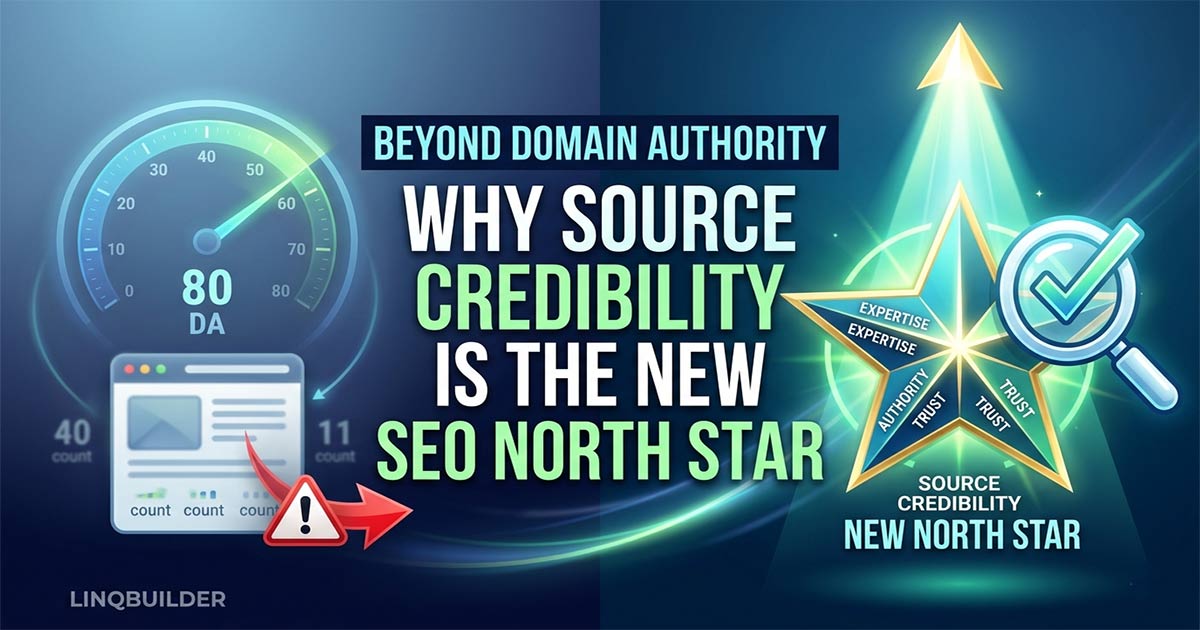
For a decade, the SEO industry has been obsessed with a single number: Domain Authority (DA). We’ve chased high-DR (Domain Rating) or DA scores like they were the holy grail of rankings. But as Google’s algorithms evolve shifting toward E-E-A-T (Experience, Expertise, Authoritativeness, and Trustworthiness) and Generative Engine Optimization (GEO) that obsession is becoming a liability.
The reality of SEO in 2026 is clear: A backlink from a DA 80 “general news” site is often less valuable than a link from a DA 30 site that is a recognized leader in your specific niche.
Welcome to the era of Source Credibility. Here is why it’s the new “North Star” for your backlink strategy and how to optimize for it.
1. The Death of the “Metric Trap”
Metrics like DA and DR are third-party guesses. While they provide a rough sketch of a site’s power, they don’t reflect how Google views Topical Authority.
Google doesn’t just ask, “Is this site powerful?” It asks, “Is this site an authority on this specific topic?” * The Old Way: Getting a guest post on a high-DA lifestyle blog to link to your SaaS product.
- The New Way: Getting a mention on a niche technical forum or an industry-specific publication with deep “Source Credibility.”
2. Why Source Credibility Wins in the Age of AI (SGE)
With Google’s Search Generative Experience (SGE) and AI Overviews, the engine is looking for citations, not just links. AI models prioritize sources that demonstrate “Information Gain”—adding new, unique value to the conversation rather than repeating common knowledge.
When a highly credible source in your industry links to you, it signals to AI models that your content is a foundational piece of the niche’s knowledge graph. This increases your chances of being the featured citation in AI-generated answers.
3. The “Traffic-to-Trust” Correlation
One of the best ways to measure Source Credibility is by looking at outbound link relevancy.
- Does the site link to other high-quality, relevant sources?
- Is the site’s audience actually clicking those links?
A link that drives referral traffic is a massive signal of credibility. If users trust the source enough to click a link, Google trusts that link enough to pass significant ranking power (Link Juice).
How to Pivot Your Link Building Strategy
To move toward Source Credibility, your outreach and guest posting strategy must change:
- Prioritize Topical Alignment: Use tools to find sites where the “Topical Flow” matches yours. If you sell “Cloud Security,” a link from a “Cybersecurity Trends” blog is worth 10x more than a link from a “General Business” site.
- Audit for “Link Neighborhoods”: Before reaching out, look at who else the site links to. If they are linking to gambling, pharma, or low-quality AI spam, their “Source Credibility” is compromised, regardless of their DA.
- Focus on Editorial Standards: The harder it is to get a link, the more it’s usually worth. Sites with strict editorial guidelines and human-vetted content are the gold mines of Source Credibility.
- Check our Linqbuilder’s Link Building services here.
Key Takeaway: Quality is a Business Decision
In the long run, chasing Source Credibility protects your site from Core Algorithm Updates. Google’s “Helpful Content” system is designed to reward natural, expert-led ecosystems. By focusing on credible sources, you aren’t just building links, you’re building a reputation.
Stop counting links. Start measuring the credibility of your sources, Consult LinqBuilder today
The Source Credibility Audit: A 7-Point Checklist
1. The “Topical Match” Test
- The Question: Does 60% or more of the site’s content relate directly to your niche?
- Why it matters: Google’s “Topic-Sensitive PageRank” rewards links from sites that are topical peers. A link from a “General News” site is a grain of salt; a link from an industry leader is a mountain.
2. The “Outbound Neighborhood” Check
- The Question: Who else is this site linking to?
- The Red Flag: If the “Recent Posts” link out to essay writing services, gambling, or “cheap” product reviews, the site is likely a link farm.
- The Green Flag: They link to high-authority (.gov, .edu, or major industry journals) sources.
3. Editorial Friction
- The Question: Is it hard to get published here?
- The Audit: Look at their “Write for Us” page. If it says “We post everything within 24 hours for $20,” run away. High-credibility sources have strict guidelines, human editors, and a high rejection rate.
4. Human Signals (The E-E-A-T Factor)
- The Question: Are there real people behind the content?
- Check for:
- Detailed “About Us” pages with real team photos.
- Author bios with links to LinkedIn or Twitter/X.
- Active social media profiles with genuine engagement (not just bot likes).
5. The “Engagement-to-Traffic” Ratio
- The Question: Does the site have “Ghost Traffic”?
- The Audit: Use a tool (like Ahrefs or Semrush) to check if the site’s traffic is stable. If they have 50k monthly visits but zero comments, social shares, or brand mentions, that traffic might be inflated by bot networks.
6. Search Generative Experience (SGE) Visibility
- The Question: Does this site show up in AI Overviews?
- The Test: Search for a core topic the site covers. If the site is cited in a Google AI Overview or “People Also Ask” section, it has high “Source Credibility” in the eyes of the LLMs.
7. Core Web Vitals & UX
- The Question: Is the site a “Link Cemetery” or a usable resource?
- The Audit: If the site is covered in intrusive pop-ups, takes 10 seconds to load, or has a broken layout, Google will eventually devalue its outbound links. Credible sources invest in their user experience.
Frequently Asked Questions (FAQ)
Q1: Is Domain Authority still relevant for link building?
While DA is a helpful metric for a quick health check, it is no longer a primary ranking factor. Google focuses more on topical relevance and the “Source Credibility” of the linking site to determine how much weight to give a backlink.
Q2: What is Source Credibility in SEO?
Source Credibility refers to the perceived trustworthiness and expertise of a linking domain within a specific niche. It is measured by editorial standards, the author’s reputation, and how well the site demonstrates E-E-A-T (Experience, Expertise, Authoritativeness, and Trustworthiness).
Q3: How does Source Credibility affect AI search results?
In the era of Generative Engine Optimization (GEO), AI models like Google’s SGE prioritize citations from highly credible sources. Links from authoritative, niche-specific sites make your content more likely to be used as a primary source in AI-generated answers.