
In the SEO world of 2026, a backlink from a site with no traffic is worse than useless, it’s a footprint for a Google penalty. The market is currently flooded with “Guest Post Farms”: websites that look beautiful and have high Domain Authority (DA) but are ignored by search engines because they have zero actual human readers.
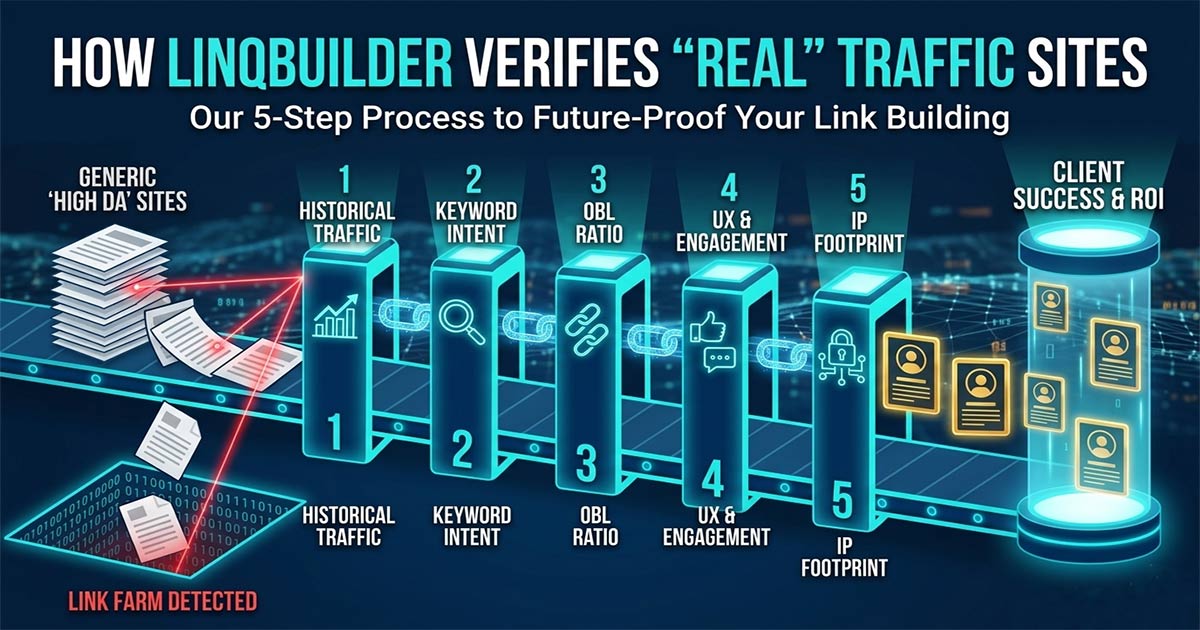
At LinqBuilder, we don’t buy into vanity metrics. We buy into authority. To ensure our clients get the highest ROI, we put every potential publishing partner through a rigorous 5-step verification gauntlet.
Here is exactly how we separate the “Real Traffic” powerhouses from the “Link Farm” pretenders.
Step 1: Historical Traffic Trend Analysis
The first thing we look at is the site’s life story. A legitimate website grows or stabilizes over time. A link farm often shows a “hockey stick” spike followed by a massive crash.
- The Check: We use tools like Ahrefs and Semrush to analyze the 2-year traffic trend. We look for consistent growth and resilience through Google Core Updates.
- The Red Flag: If a site lost 80% of its traffic during a recent “Helpful Content Update,” we blacklist it. Google has already spoken that site is no longer a trusted source.
2. Keyword Intent & “Value” Vetting
Not all traffic is created equal. A site might have 100,000 visitors, but if they are all ranking for “random celebrity net worth” or “unrelated song lyrics,” that traffic won’t help your SEO.
- The Check: We audit the top 100 keywords the site ranks for. Are they commercially relevant? Are they in your niche?
- The Goal: We look for sites ranking for “How-to” and “Best of” terms in your specific industry. This signals that the site has Topical Authority.
3. Outbound Link (OBL) Ratio Audit
A “Real” site exists to serve its readers. A “Link Farm” exists to sell posts. You can tell the difference by looking at what they link to.
- The Check: We scan the site’s recent articles. If every single post contains a suspicious link to a casino, a crypto site, or an unrelated essay writing service, the site is a farm.
- The Standard: We only partner with sites where the majority of content is editorial and link-free, or links only to high-authority reference sites like Wikipedia or major news outlets.
4. Manual “Human-Eye” UX & Engagement Check
AI and tools can be fooled, but a human expert rarely is. Our strategists manually visit every site to perform a “vibe check.”
- The Check: * Comments: Are there real humans discussing the posts?
- Design: Does the site look like it was made for users, or does it look like a generic WordPress template stuffed with ads?
- Social Signals: Does the site have an active following on LinkedIn, X, or Pinterest?
- The Goal: If the site feels like a ghost town, we move on. Real traffic leaves a digital trail.
5. IP and Hosting Footprint Verification
Sophisticated link networks (PBNs) often host hundreds of sites on the same server or use identical Google Analytics IDs.
- The Check: We use technical tools to check for “Shared Footprints.” If we find that 10 different “niche blogs” are all sharing the same IP address or the same WHOIS information, we flag them as a network.
- The LinqBuilder Guarantee: We only secure links from independent, standalone websites that have no technical connection to one another.
Comparison: LinqBuilder Standards vs. The “Cheap” Alternative
| Metric | Cheap “Bulk” Providers | LinqBuilder Process |
| Verification | Automated / None | Manual 5-Step Vetting |
| Site Type | Generalist Link Farms | Niche-Relevant Authorities |
| Traffic | Often Botted or Zero | Verified Human Organic Traffic |
| Safety | High Risk of Penalty | Future-Proof / White-Hat |
Conclusion: Quality is the Best Discount
You might save $50 today by buying a “high DA” link from a spreadsheet, but the cost of recovering from a Google manual action is thousands.
By using our 5-step verification process, LinqBuilder ensures that your backlink profile is built on a foundation of real authority, real traffic, and real results.
Stop Guessing. Start Growing. Get Verified Links Today
FAQs’
Q: Why is “Real Traffic” more important than Domain Authority (DA)?
A: DA is a third-party metric that can be easily manipulated (inflated) by spammy backlinks. Real traffic, however, is much harder to fake. If Google is sending thousands of visitors to a site, it’s a definitive signal that Google trusts that domain. A link from a trusted domain passes significantly more “ranking power” to your site.
Q: Do you use automated tools for the entire 5-step process?
A: No. While we use industry-leading tools like Ahrefs and Semrush for data collection, the final “vibe check” (Step 4) and footprint verification (Step 5) are performed by human SEO strategists. AI and software often miss the subtle nuances that distinguish a high-quality blog from a sophisticated link farm.
Q: What happens if a site’s traffic drops after you’ve secured a link?
A: Minor fluctuations are normal. However, because our Step 1 analyzes long-term stability and resilience to past updates, the sites we choose are far less likely to suffer catastrophic drops. We aim for “Blue Chip” sites that have survived multiple Google Core Updates.
Q: Can I see the traffic stats of a site before I approve a guest post?
A: Absolutely. Transparency is a core value at LinqBuilder. We provide our clients with the traffic data and relevancy metrics for every placement we suggest, ensuring you are 100% confident in the authority being built.