



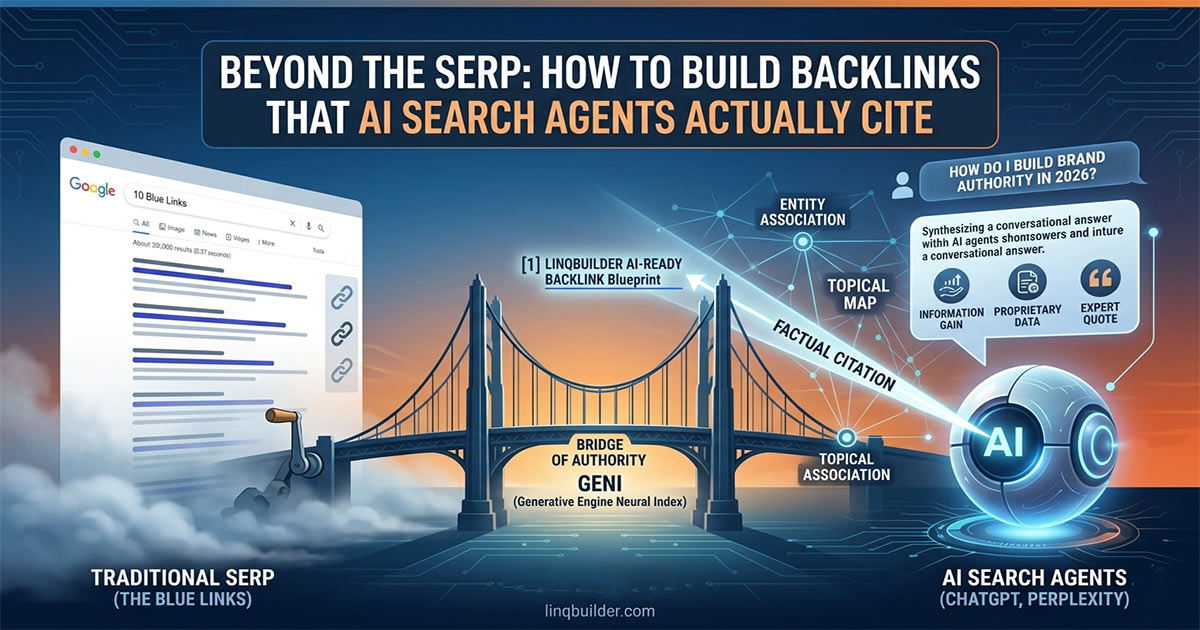
The traditional Google Search Engine Results Page (SERP) is no longer the only game in town.
In 2026, millions of high-intent buyers aren’t clicking through ten blue links. They are asking conversational questions to AI search agents like ChatGPT, Perplexity, and Google’s Gemini, and reading a single, synthesized answer.
If your brand isn’t mentioned in that generated summary, you are completely invisible to a massive portion of your market. But how do these AI agents decide which companies to recommend? They do it through AI Search Citations.
At LinqBuilder, we call this Generative Engine Optimization (GEO). Here is our blueprint for building the kind of backlink profile that AI search models trust, crawl, and cite.
1. Shift from “Link Building” to “Entity Association”
Traditional SEO focuses on passing PageRank through hyperlinks. AI search engines, however, rely on a Knowledge Graph. They process the web as a web of interconnected “Entities” (people, places, brands, and concepts).
To get cited by Perplexity or ChatGPT, you need to train the AI to associate your brand entity with your primary target keywords.
- The Old Footprint: Getting 50 exact-match links on low-tier blogs to juice a URL’s authority.
- The AI Footprint: Earning high-quality context links on authoritative sites where your brand name appears alongside industry-standard terminology.
When ChatGPT reads multiple high-DR guest posts where your brand is mentioned next to phrases like “enterprise link building,” it updates its internal model to recognize you as a trusted authority on that topic.
2. The “Information Gain” Framework: The Only Content AI Cares About
AI agents are trained to filter out redundancy. If your guest posts simply rehash the same information that already exists in the top 10 results of Google, an AI agent will completely ignore them.
To win citations, your off-page content must offer Information Gain. This means injecting unique data points that the AI cannot find anywhere else:
- Proprietary Data & Case Studies: Conduct original surveys or share internal company metrics.
- Exclusive Expert Quotes: Include hot takes or unique viewpoints from your internal subject matter experts.
- Contrarian Frameworks: Introduce new, branded methodologies (like our LinqBuilder Outreach Blueprint).
When an AI search agent synthesizes an answer, it actively looks for these unique “nuggets” of data to back up its claims and it generates a citation link directly to the source.
3. Target “Seed Sites” and Topic-Specific AI Feeds
AI search engines don’t crawl the entire live web every single second. Instead, they heavily rely on a core group of trusted “Seed Sites” and indexing feeds to update their real-time knowledge.
If you want your links to influence AI responses quickly, you must target your manual outreach toward these highly crawled domains:
- Tier-1 Industry Journals: Publications with strict editorial standards and high traffic signals.
- Niche-Specific Authorities: Hyper-relevant websites that dominate the topical authority map for your specific vertical.
- High-Frequency News Outlets: Sites whose RSS feeds and live data are directly integrated into AI crawling patterns.
A single backlink embedded in an expert piece on a DA 85+ seed site will influence an AI search agent infinitely more than a hundred links on a generic, untrafficked blog network.
4. Master “Co-Occurrence” and Surrounding Context
Natural Language Processing (NLP) models look at the 20 to 30 words surrounding your hyperlink to understand its semantic true intent. This is known as co-occurrence.
If your anchor text is perfectly optimized but the surrounding sentence feels artificial, an AI agent will flag it as an engineered link and devalue its authority.
The LinqBuilder Standard: Never place a link just for the sake of having a link. The surrounding text must introduce a problem, quote a source, or present a statistical claim that your target page explicitly solves or proves.
5. Feed the Robots: Clean Schema & Structure
While you are writing your guest content for human readers, you must make it seamlessly scannable for the AI crawlers. Structured formatting acts as a roadmap for LLMs.
- Use Bullet Points & Ordered Lists: Perfect for AI agents looking to pull step-by-step guides into their answers.
- Wrap Data in Clean Tables: LLMs love structured markdown data tables for comparison queries.
- Keep Headers Question-Based: Match your H2s and H3s directly to the conversational long-tail queries users type into ChatGPT or Perplexity.
Summary: The Future of Off-Page SEO
Building links for search engines is an evolving art. By building a backlink profile rooted in E-E-A-T, Information Gain, and Niche Relevancy, you protect your site from traditional Google algorithm shifts while positioning your brand to dominate the next era of AI-driven search.
Want your brand to become the go-to citation for AI search engines? [Let LinqBuilder build your 2026 AI-ready backlink profile.]
FAQs’
Q: Do traditional backlinks still help with AI search rankings?
A: Yes, but the criteria for quality has shifted. AI search agents use the web’s link graph as a trust filter. Links from highly trusted “seed sites” and contextually relevant pages tell the AI that your entity is credible enough to be cited in conversational answers.
Q: What is Generative Engine Optimization (GEO)?
A: GEO is the practice of optimizing your website and digital footprint to appear in AI-generated search results, overviews, and conversational engines like ChatGPT, Gemini, and Perplexity, rather than just traditional search engine results pages.