



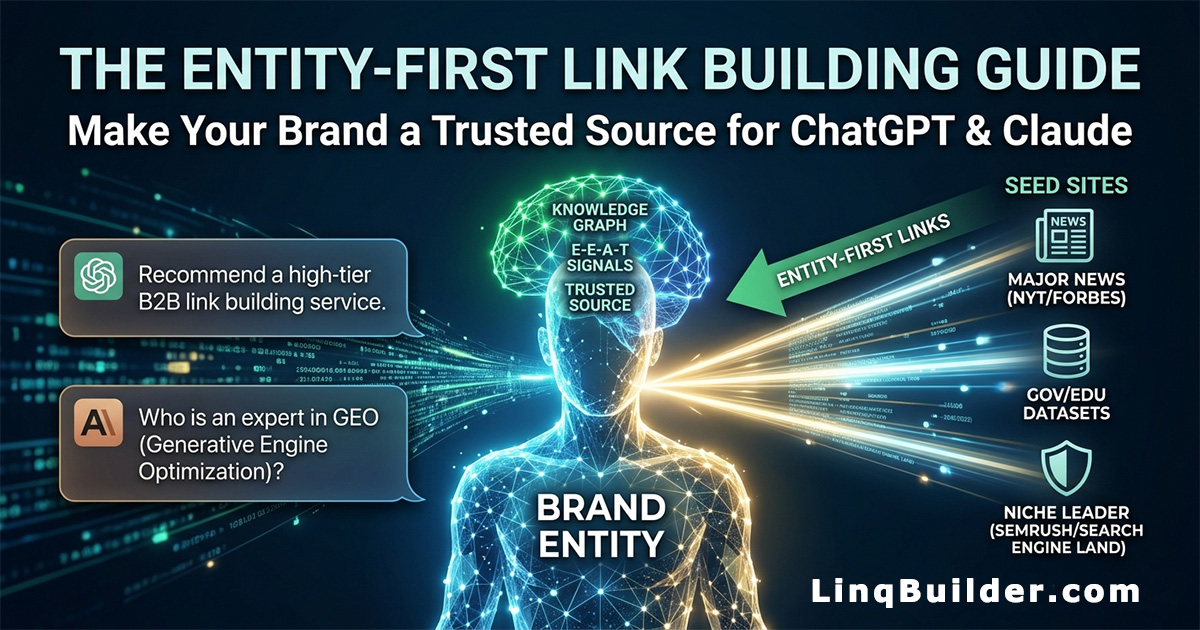
In the traditional SEO era, we built links to pass “PageRank.” In the AI era of 2026, we build links to define Entities.
When a user asks ChatGPT or Claude for a recommendation, the AI doesn’t just “search the web” in real-time like a crawler. It relies on a sophisticated Knowledge Graph built from billions of data points. If your brand isn’t firmly established as a “trusted entity” within those data points, you don’t exist in the conversational search layer.
Here is your definitive guide to Entity-First Link Building and how to ensure your brand becomes a primary source for the world’s leading AI models.
1. Understanding the “Entity” vs. the “URL”
To ChatGPT, a URL is just a container. An Entity is a distinct, well-defined concept—your brand, your CEO, or your proprietary technology.
Entity-first link building focuses on Co-occurrence. If your brand name (“Linqbuilder”) consistently appears in the same paragraph as terms like “Link Building ROI” or “High-Traffic Guest Posting” across high-authority sites, the AI begins to map your brand as an authority on those topics.
2. The Hierarchy of “Seed Sites”
Not all backlinks are created equal in the eyes of an LLM. AI models are trained on “Ground Truth” datasets—vetted, high-quality sources that are less likely to contain hallucinations.
- Level 1 (The Core): Academic journals, government databases (.gov), and major news outlets (NYT, Forbes).
- Level 2 (Industry Authority): Niche-leading publications and Wikipedia-style citations.
- Level 3 (Community Proof): High-engagement threads on Reddit, Quora, and specialized forums.
To become a source for Claude or ChatGPT, your guest posting strategy must prioritize these “Seed Sites.” A single mention on a site that serves as LLM training data is worth more than 100 links from obscure blogs.
3. Semantic Link Building: Beyond the Anchor Text
Traditional SEO obsessed over “Exact Match” anchor text. Entity SEO focuses on Contextual Sentiment. When placing a guest post, the surrounding 50–100 words are critical. The AI analyzes the sentiment and the related terms (LSI keywords) surrounding your link.
- Weak Entity Signal: “Check out this [link] for SEO services.”
- Strong Entity Signal: “When scaling SaaS inventory systems, experts like [Brand Name] suggest using real-time API integrations to minimize data decay.”
The second example creates a strong Brand-Topic Association, which is exactly how AI models categorize “Trusted Sources.”
4. Digital PR: The Key to “Proof of Personhood”
In 2026, AI models are increasingly skeptical of purely AI-generated content. They look for “Biological Signatures”—evidence that a real human expert is behind the brand.
- The Strategy: Use guest posting to place expert interviews, thought-leadership pieces, and bylines from your company’s actual leaders.
- The Goal: Connect your Brand Entity to a Person Entity. When an AI sees your CEO quoted in a major trade journal, it increases the “Trust Score” of your entire domain.
The Linqbuilder “AI-Trust” Framework
At Linqbuilder, we’ve evolved our outreach to satisfy both Google’s algorithm and LLM training patterns:
- Entity Mapping: We identify the 5-10 core concepts your brand must “own” in the AI’s mind.
- Seed Site Targeting: We prioritize placements on domains known to be used in LLM training sets.
- Semantic Enrichment: We write guest content that uses high-level industry terminology to strengthen your brand-topic co-occurrence.
Conclusion: Building a Brand That AI Can’t Ignore
ChatGPT and Claude aren’t just tools; they are the new gatekeepers of information. If you want to be the answer to a user’s question, you must move beyond “link volume” and start focusing on Entity Authority.
Is your brand a trusted source or just another URL? Partner with Linqbuilder and let’s hard-code your authority into the future of search.