


Buying guest posts can be a powerful way to build backlinks, increase brand awareness, and drive traffic to your website. But it’s also a risky business. The web is full of low-quality sites that exist solely to sell links. If you’re not careful, you could end up wasting your money on a backlink that does more harm than good. In the worst-case scenario, you could even face a Google penalty.
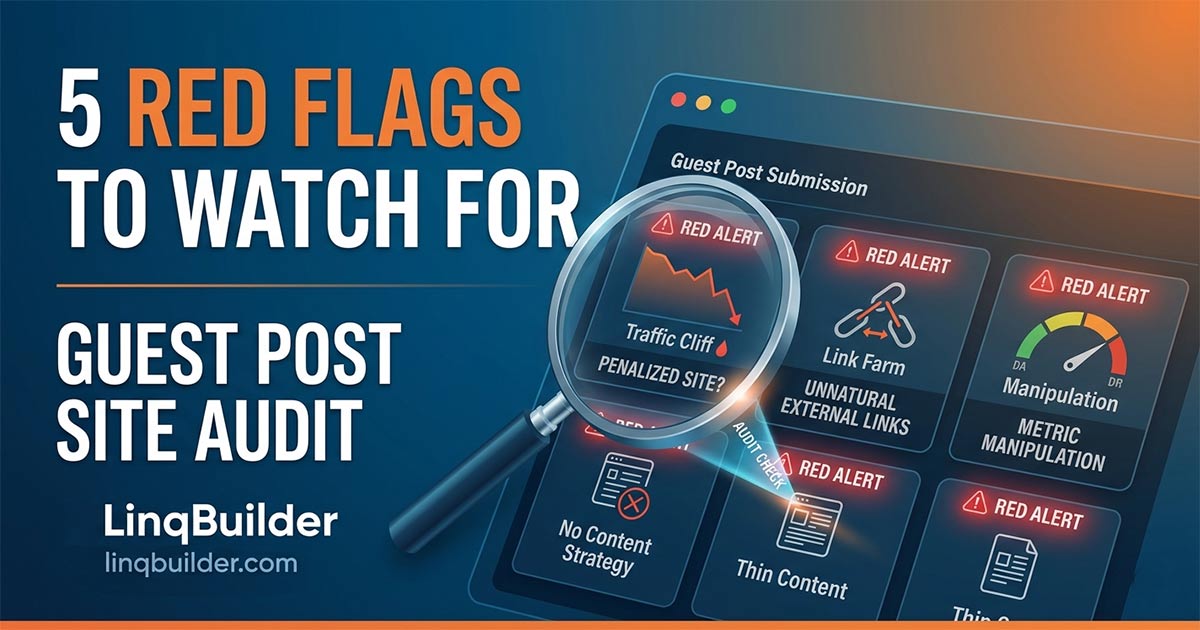
Before you hand over your hard-earned marketing budget, it’s crucial to perform a thorough guest post audit. You need to look beyond vanity metrics and scrutinize the actual quality, relevance, and health of the site you’re considering. Here’s how to do it, and the 5 critical red flags you should never ignore.
The Importance of a Content and Link Profile Audit
A generic look at Domain Authority (DA) or Domain Rating (DR) is not enough. These metrics can be manipulated. A true audit means examining the “soul” of the website—its content, its linking practices, and its overall user experience. You are looking for a natural, authentic site, not a link farm dressed in a pretty theme. Think of this process as part of your overall content strategy and planning. A single high-quality, relevant guest post can be more effective than dozens of low-quality, generic ones.
Red Flag #1: Manipulated Authority Metrics (DA/DR)
It’s tempting to filter by DA 50+ and assume everything is fine. But sophisticated link sellers have learned how to artfully boost these scores. They use private blog networks (PBNs) or aggressive, unnatural link building services to pump up the numbers.
How to Spot It: Use a tool like Ahrefs, Semrush, or Moz to look at the site’s historical backlink data.
- A sudden, massive spike in backlinks with no corresponding increase in traffic is a huge red flag.
- The link velocity should look natural. Steady, organic growth is ideal. A vertical line on the graph usually means black-hat tactics are at play.
- Analyze the referring domains. Are they also high-quality, or do they look like spammy, unrelated sites?
A site with a modest but natural DR 30 is infinitely safer and more valuable than a site with a DR 70 built on a foundation of PBN links.
Red Flag #2: A Thin and Irrelevant Content Profile
The content on the site is the single biggest indicator of its health. When a site exists primarily to sell links, the content suffers. This goes directly against Google’s helpful content update principles.
How to Spot It: Spend five minutes actually reading the site.
- Look at the “About” and “Contact” pages. Do they seem like real people run the site?
- Read recent articles. Is the content well-written, insightful, and comprehensive? Or is it generic “top 5” lists filled with grammar mistakes and awkward, keyword-stuffed sentences?
- Is the content relevant to its stated niche? If a “marketing blog” suddenly has an in-depth article about the “best portable pet dynamic travel carriers,” it’s a link farm. These sites will accept any content as long as the check clears. Google notices this lack of topical authority and will devalue the links accordingly.
- Look for a clear author profile. While not always possible with guest posts, real editorial sites value their writers. A site where every article is by “Admin” or a generic name is suspect.
Red Flag #3: Unnatural External Linking Practices
A legitimate editorial site manages its external links carefully. It only links out to high-quality, relevant sources that provide value to the reader. A link farm has no such discretion.
How to Spot It:
- Check the outbound links in recent articles. A major red flag is if nearly every article on the site is clearly a guest post, and each one links out to a totally different, commercial, and irrelevant website. You’ll see a marketing article linking to a “Singapore essay writing service” one day, and a real estate article linking to “cryptocurrency trading platforms” the next. This is classic link farm behavior.
- Are the links using exact-match anchor text? A site that allows dozens of links with anchors like “buy cheap dynamic dog travel carriers” is screaming “penalize me, Google.” Natural linking uses a variety of anchor text, including branded, partial-match, and generic terms.
Red Flag #4: No Traffic (or Drastic Traffic Drops)
A site that claims to have high authority but receives no organic traffic is almost certainly penalised or has its traffic entirely on the way down. Why would you want a link from a site that no one visits? You aren’t just buying a link; you are buying visibility and credibility. Referral traffic from a guest post can be highly valuable if the site has a real audience.
How to Spot It: Check the site’s organic traffic in Semrush or Ahrefs.
- A “Traffic Cliff”: If you see a historical graph where traffic suddenly plummeted to near-zero, the site was likely hit by a Google algorithm update or a manual penalty. It may never recover. Avoid it.
- Flatline Traffic: A high-DR site with a completely flat, non-existent traffic graph is a “zombie site.” Its metrics are high, but it has no value in the eyes of Google.
- Search for the domain in Google: Search for
site:thedomain.com. If nothing shows up, the site has been de-indexed. This is the ultimate red flag.
Red Flag #5: The Site Openly Advertises Link Sales
This might seem obvious, but it’s crucial. A true guest posting service involves outreach, relationship building, and high-quality content that provides genuine value to the hosting site. Sites that publicly advertise “Contribute a Post,” “Become a Contributor,” or worse, “Buy Guest Posts $50” are on Google’s radar.
How to Spot It:
- Look for a dedicated page with “Write for Us” guidelines. This is common, but it’s a potential red flag if the guidelines are weak or don’t exist, and the focus is clearly on the volume of content rather than quality.
- Scan the footer for phrases like “Contribute a Post” or “Sponsored Posts.”
- If a link seller can show you this page, Google can find it too. Using these sites leaves a clear “footprint” that Google can use to devalue all links from that domain, and potentially penalize your site.
Conclusion: Prioritize Quality and Relevance
Don’t let the pressure to build links make you desperate. A successful white-hat link building campaign requires patience and a commitment to quality. Before you buy, audit. Look for authentic, relevant sites with well-written, useful content and a natural link profile. A single link from a genuine, active blog will provide more long-term value than ten risky links from automated link farms. Protect your site’s integrity by watching for these 5 critical red flags.
Consult LinqBuilder for Wide-Range of Link Building and Related services.
Linqbuilder.com
Frequently Asked Questions (FAQ)
Q: Is a high Domain Authority (DA) enough to trust a guest posting site?
A: Absolutely not. DA is a third-party metric that can be easily manipulated through spammy link injections. Always cross-reference DA with organic traffic and topical relevance to ensure the site has real authority in Google’s eyes.
Q: What is a “Link Farm” and why should I avoid them?
A: A link farm is a website created solely to sell outbound links. They usually cover unrelated topics (e.g., gambling, health, and tech on one page) and have no real readership. Google’s AI models easily identify these patterns and can devalue or penalize any site associated with them.
Q: How much organic traffic should a guest post site have?
A: There is no “magic number,” but you should look for consistency. A site with at least 500–1,000 monthly organic visitors shows that Google trusts the domain enough to rank its content. Avoid sites with “Traffic Cliffs” (sudden drops to zero).
Q: Does the “Write for Us” page make a site a red flag?
A: Not necessarily. Many legitimate publications have “Write for Us” pages to find expert contributors. The red flag appears when the page openly mentions “dofollow links” for a fee or has zero editorial standards for the content they accept.