



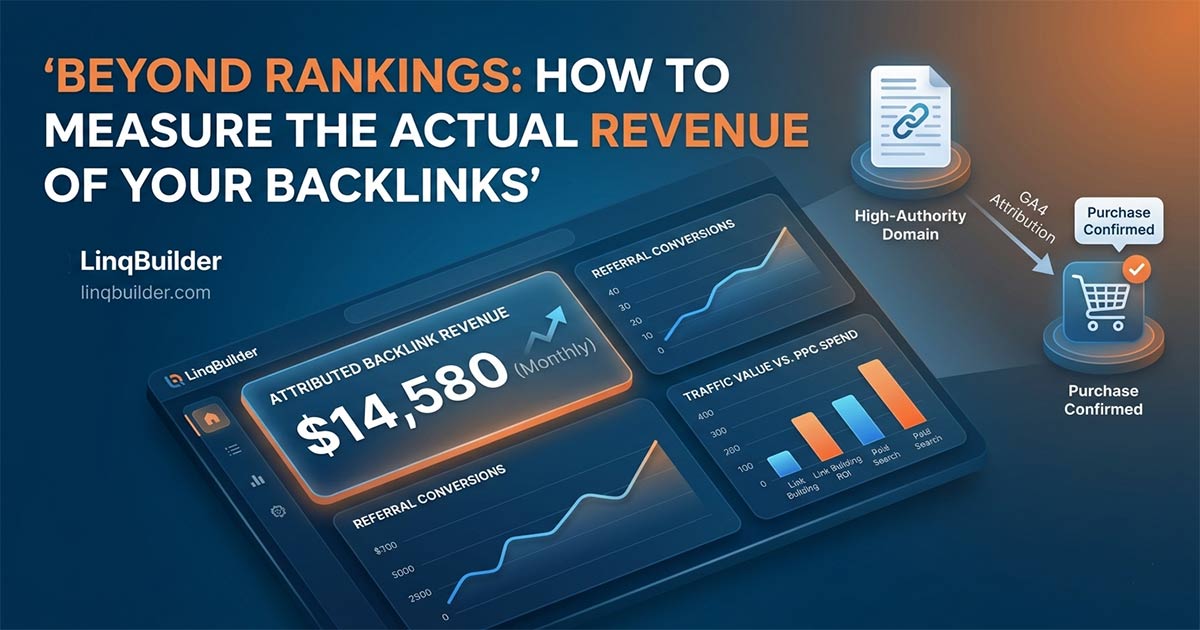
The Evolution of SEO Metrics: Why Rankings Aren’t Enough in 2026
In the early days of SEO, a jump from page five to page one was the ultimate victory. But in 2026, rankings are just the “noise” revenue is the signal. For businesses investing in high-quality guest posting and link building, the question has shifted. It’s no longer just “Where do I rank?” but “How much did that backlink actually contribute to my bottom line?”
If you aren’t measuring the financial impact of your link profile, you’re flying blind. Here is the framework for moving beyond vanity metrics to track the real-world ROI of your backlink strategy.
1. The Shift from Visibility to Attribution
Rankings fluctuate, but attribution is permanent. To measure revenue, you must understand how a user travels from a referral link to a checkout page. In digital marketing, this is called Attribution Modeling.
- First-Touch Attribution: Credits the backlink that first introduced the user to your brand.
- Assisted Conversions: Highlights backlinks that didn’t result in an immediate sale but appeared midway through the customer journey.
Why it matters: A guest post on a high-authority niche site might not sell a product today, but it builds the “Source Credibility” that makes a user click your Google Search result three weeks later.
2. Tracking Referral Traffic Conversions in GA4
The most direct way to measure backlink revenue is through Referral Traffic analysis. Using Google Analytics 4 (GA4), you can isolate traffic coming specifically from your link-building efforts.
How to do it:
- Navigate to Reports > Acquisition > Traffic Acquisition.
- Filter the primary dimension to Session source/medium.
- Look for your guest post domains (e.g.,
high-authority-niche-site.com / referral). - Check the Revenue and Conversion Rate columns specifically for those sources.
Pro Tip: Use UTM Parameters on your guest post links whenever possible. This allows you to track exactly which specific article or anchor text is driving the most high-intent buyers.
3. Calculating “Traffic Value” (The PPC Shortcut)
If your links are helping you rank for commercial keywords, you can estimate their revenue impact by looking at Traffic Value. This metric calculates how much you would have spent in Google Ads (PPC) to get the same amount of traffic.
- The Formula:
Organic Clicks x Average CPC = Traffic Value
If a backlink pushes your “SaaS System” page to position #1, and that keyword costs $15 per click, 1,000 monthly visits are worth $15,000 in saved ad spend. That is direct, measurable profit added back into your marketing budget.
4. Measuring LTV (Lifetime Value) of SEO Leads
Not all leads are created equal. Data consistently shows that users who discover a brand through an authoritative editorial mention (a backlink) often have a higher Customer Lifetime Value (CLV) than those from “interruption” ads.
- Referral Leads: Usually come with higher trust because they were “recommended” by a third-party site.
- Action Step: Tag your SEO-acquired leads in your CRM (like HubSpot or Salesforce). Compare their retention rate and average order value against your paid social or search leads.
5. The “Brand Lift” Effect
High-quality link building acts as a digital PR tool. When you are featured on authoritative sites, your Branded Search Volume (people searching specifically for “LinqBuilder”) typically increases.
Branded traffic has the highest conversion rate of any channel. By correlating your link-building velocity with the growth in branded search, you can see the “halo effect” your links have on direct revenue.
Summary: The Backlink ROI Checklist
To stop guessing and start measuring, track these four KPIs monthly:
| Metric | Tool | What it Tells You |
| Referral Conversion Rate | GA4 | Direct sales from guest posts. |
| Organic Traffic Value | Ahrefs/Semrush | Money saved vs. Paid Ads. |
| Assisted Conversions | GA4 | How links support the final sale. |
| Branded Search Growth | Google Search Console | Increase in brand authority & trust. |
Final Thought: Invest in Revenue, Not Just Links
At the end of the day, a link is a bridge. If that bridge connects a high-authority audience to your high-value content, revenue is the natural result. Stop chasing “DA 90” sites that have no relevance, and start building links that act as revenue-generating assets – Contact LinqBuilder for revenue generating backlink building.
Frequently Asked Questions (FAQ)
Q: Can you actually track a sale back to a single backlink?
A: Yes. By using UTM parameters on your guest post links and analyzing the “Referral” traffic report in GA4, you can see exactly which domains are sending users who complete a purchase or sign up for a service.
Q: What is the average ROI of a high-quality link building campaign?
A: While it varies by niche, businesses often see a “Traffic Value” increase that is 3–5x their initial investment within 6–12 months, as organic rankings for high-intent keywords stabilize.
Q: Is Domain Authority (DA) a good indicator of revenue potential?
A: Not necessarily. A link from a DA 40 site that is perfectly relevant to your niche (e.g., a restaurant tech blog for a POS company) will drive more revenue-qualified leads than a generic DA 90 news site.
Q: How do backlinks assist in “Indirect Revenue”?
A: High-authority backlinks build “Source Credibility.” When a user sees your brand mentioned on a trusted industry site, they are more likely to click your organic search result later, increasing your overall Click-Through Rate (CTR).