



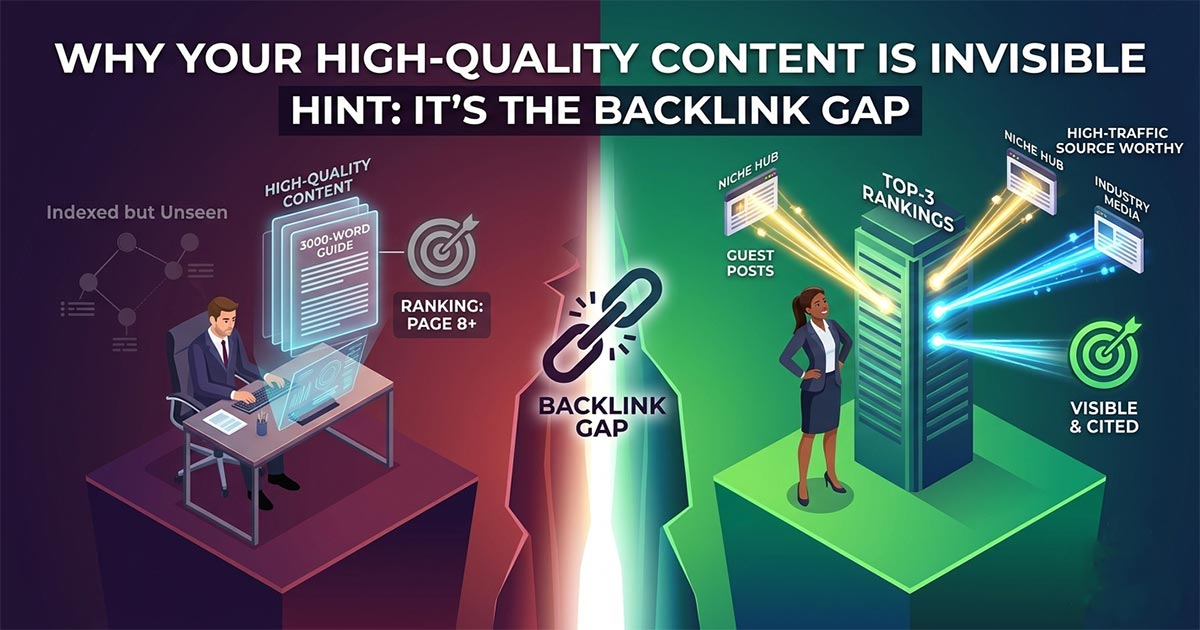
You’ve done everything “by the book.” You hired a subject matter expert, optimized for long-tail keywords, and published a 3,000-word guide that is objectively better than anything else on page one.
Then you wait. Three months later, your masterpiece is sitting on page 8, while a 500-word fluff piece from 2022 sits comfortably in the top three.
Is the algorithm broken? No. You are likely suffering from a Backlink Gap. In the 2026 search landscape, high-quality content is merely the ticket to enter the race backlinks are the fuel that gets you to the finish line.
1. The “Quality Paradox”: Why Content Isn’t Enough
Google’s AI-driven algorithms (like the latest Core updates) are designed to find the “best” answer. However, with millions of pages published daily, Google uses Backlinks as a Proxy for Trust.
If two pages are equal in quality, but Page A has 50 links from authoritative industry sites and Page B has zero, Google will always prioritize Page A. Why? Because the internet has “voted” for it. Without links, your content exists in a vacuum. It lacks the topical validation required to move from “Indexed” to “Ranked.”
2. What is the Backlink Gap?
The Backlink Gap is the numerical and qualitative difference between your site’s link profile and that of the competitors currently occupying the top spots for your target keyword.
The Three Layers of the Gap:
- The Volume Gap: Competitors have 200 referring domains while you have 20.
- The Authority Gap: Competitors have links from
.edu,.gov, and Tier-1 media outlets; you have links from small, unknown blogs. - The Relevance Gap: Competitors have links from sites directly in your niche; your links are scattered across unrelated industries.
3. The “Crawl Budget” Bottleneck
In 2026, Google is more selective than ever about what it crawls and indexes to save resources for AI processing. High-quality backlinks act as “Highways” for Google’s bots.
- The Reality: If no authoritative sites are linking to your new content, Google’s bots may only visit your page once a month.
- The Fix: A few strategic guest posts on high-traffic sites act as a “ping,” forcing Google to re-evaluate and re-index your content more frequently.
4. How to Close the Gap and Reclaim Visibility
To move from page 8 to the top of the AI Overviews, you need a Link-to-Content Ratio strategy:
Step 1: Perform a Competitive Audit
Use tools like Ahrefs or Semrush to look at the “Link Intersect.” Find the sites that link to all your top-3 competitors but not to you. These are your “Low Hanging Fruit” targets.
Step 2: Invest in “Information Gain” Outreach
Don’t just ask for links. Use your high-quality content as a “Linkable Asset.” Reach out to editors with a specific insight or data point from your article that their readers would find valuable.
Step 3: Prioritize “Source Worthiness”
Stop chasing DA. Focus on Source Worthiness placing guest posts on sites that have actual human traffic. One link from a busy industry hub is worth 1,000 links from “Ghost Sites.”
The Linqbuilder Solution: Bridging the Gap
At Linqbuilder, we specialize in identifying and closing the Backlink Gap. We don’t just build links; we build the Authority Infrastructure your content needs to be seen.
Our process includes:
- Gap Mapping: We identify exactly how many (and what kind) of links you need to beat your specific competitors.
- Contextual Placement: We place your brand in the “Digital Neighborhoods” where your customers and Google’s bots live.
- Authority Injection: We secure placements on Tier-1 and Tier-2 sites that pass maximum trust to your invisible content.
Conclusion: Content is the Seed, Links are the Water
If you have a world-class seed but never water it, nothing will grow. Stop letting your best work go to waste. Close the backlink gap and give your content the visibility it deserves.
Tired of being invisible? Contact Linqbuilder today for a free Backlink Gap Analysis and let’s get you to page one.