


In 2026, the internet has no borders, but search engine algorithms certainly do. If you are an American SaaS company trying to rank in the UK, or an Indian marketplace expanding into Australia, you cannot simply replicate your domestic strategy.
A common mistake is “Link Dumping”—buying guest posts in bulk from .com sites and hoping they’ll move the needle in France or Japan. They won’t.
To succeed globally, you need a Localized Link Ecosystem. Here is how to scale your international guest posting without diluting your brand’s relevance.
1. The “ccTLD” Priority: Why Domain Extensions Matter
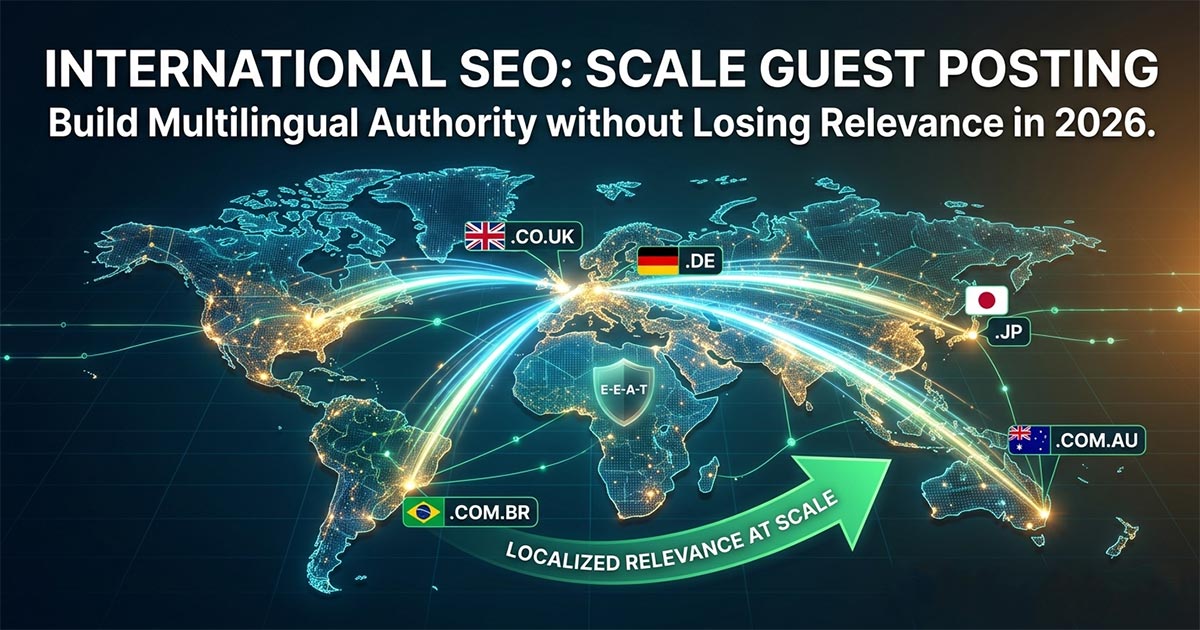
In International SEO, the “location” of the link is a primary signal. While a .com link is globally powerful, search engines like Google and local players (like Yandex or Baidu) prioritize ccTLDs (country-code Top-Level Domains) for regional queries.
The Strategy: When scaling your outreach, ensure at least 40% of your link profile comes from local extensions (e.g., .co.uk, .de, .com.au). This tells the algorithm that local authorities trust your brand within that specific geography.
2. Translation vs. Transcreation in Outreach
One of the biggest ROI killers in international guest posting is bad translation. AI translation has improved, but it often misses cultural nuances that an editor in a specific market will spot instantly.
- The Problem: Direct translation of an English guest post often results in awkward phrasing and incorrect LSI keywords.
- The Solution (Transcreation): You must rewrite the guest post with a local perspective. A post about “Real Estate Investment” in New York requires entirely different data points and cultural references than one for the London or Dubai markets.
3. Coordinating Hreflang with Link Building
If you have a multilingual site (e.g., example.com/en/ and example.com/es/), your guest posting must be surgically targeted.
If you secure a guest post on a high-authority Spanish blog, that link must point to your /es/ subfolder or your .es domain. If you point international links to your generic English homepage, you create a “Relevance Mismatch” that confuses the AI models responsible for geo-targeting.
4. Navigating Regional Link Building Laws & Ethics
Different markets have different standards for “Sponsored Content” and guest posting.
- Europe (GDPR/EU Law): Editors are often stricter about labeling guest contributions.
- USA (FTC): Requires clear disclosure.
- Asia-Pacific: Often relies more heavily on PR-style outreach and social validation.
To scale without losing relevance, you must adapt your Editorial Guidelines to match the cultural expectations of the local editor.
The Linqbuilder Global Blueprint
At Linqbuilder, we don’t just “blast” links globally. We use a Market-First approach:
- Local Competitor Analysis: We identify where your regional competitors are getting their “Source Worthy” links.
- Native Content Creation: Our writers are proficient in regional nuances, ensuring your guest posts read like they were written by a local expert.
- Geo-Specific Outreach: We maintain a database of high-traffic ccTLD sites that are difficult for generic agencies to access.
Conclusion: Global Scale Requires Local Roots
Scaling your international SEO isn’t about doing more of the same; it’s about doing the same thing differently in every market. By focusing on localized relevance, you don’t just build links you build a global empire.
Is your brand lost in translation? Partner with Linqbuilder to build a localized, high-authority backlink profile that dominates global search results.