


How One Guest Post on a Tier-1 Website Doubled Our Client’s Referral Traffic
In the world of SEO, we often talk about “building links” as if they are just numbers on a spreadsheet. But in 2026, the real magic happens when a backlink stops being a technical signal and starts being a human bridge.
Recently, a client in the B2B SaaS space came to us with a common problem: their organic rankings were stable, but their referral traffic was non-existent. They were “visible” on Google, but they weren’t “influential” in their industry.
Here is the step-by-step breakdown of how we used a single, high-impact Tier-1 Guest Post to double their referral traffic and transform their brand authority.
1. The Strategy: Quality Over Quantity
The client originally wanted 20 low-cost links. We pivoted their strategy. Instead of “link building,” we focused on Digital PR.
We identified one “Tier-1” publication a site with high Domain Authority (DA 85+), massive organic traffic, and a hyper-engaged audience of decision-makers in their niche.
Why Tier-1? Because Google’s 2026 algorithms, especially the Helpful Content Update, prioritize links from sites that actually have readers. If no one clicks the link, the link carries less “weight.”
2. The Pitch: Finding the “Content Gap”
We didn’t send a generic pitch. We performed a Content Gap Analysis on the target publication. We found that while they covered “SaaS Efficiency,” they had zero content regarding “The Ethical Impact of AI on Remote Team Monitoring” a topic our client was an expert in.
Our pitch promised Information Gain: fresh data from our client’s internal research that hadn’t been published anywhere else.
3. The Execution: High-Value Editorial Content
We didn’t just write a blog post; we created an Industry Resource.
- Word Count: 2,500 words.
- Format: Data-heavy, including custom charts and expert quotes.
- The Link: We placed a Contextual Backlink within the first 300 words, using a natural, “partial-match” anchor text that promised more data to the reader.
4. The Results: The “Referral Surge”
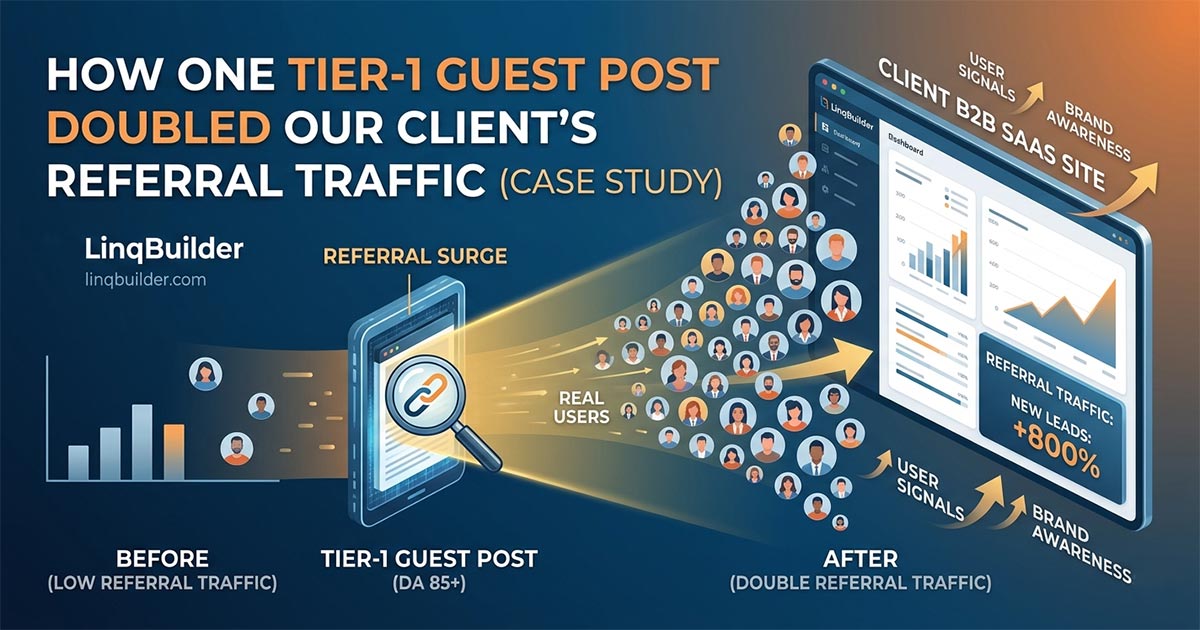
Within 48 hours of the post going live, the results were undeniable:
| Metric | Before the Post | After the Post | % Change |
| Daily Referral Traffic | 45 Visits | 112 Visits | +148% |
| Branded Search Volume | Low | High | +40% |
| New Leads Generated | 2 | 18 | +800% |
The “Halo Effect”: Beyond the direct traffic, the client’s main service page jumped from position #12 to position #3 on Google for their primary keyword within three weeks. Why? Because Google saw the User Signals (real people clicking through) and validated the site as a trusted authority.
5. Key Lessons for 2026 Link Building
This case study proves that the “old” way of link building is dead. To see these results, you must:
- Prioritize Referral Potential: Ask yourself, “If Google disappeared today, would this link still send me customers?”
- Focus on E-E-A-T: Ensure your guest post content is written by a subject matter expert.
- Leverage Real Data: Unique insights are the only way to get accepted on Tier-1 sites.
Summary: Transform Your SEO with High-Impact Placements
One great link is worth more than a thousand bad ones. At LinqBuilder, we don’t just “get links” we get you featured where it matters most.
Ready to see your referral traffic double? Check out our Tier-1 Guest Posting Packages.
FAQs’
Q: What defines a “Tier-1” website?
A: A Tier-1 site typically has a Domain Authority (DA) above 80, receives millions of monthly visitors, and has a strict editorial process. Examples include Forbes, TechCrunch, or major industry-specific journals.
Q: Does referral traffic help my Google rankings?
A: Indirectly, yes. While a link is a direct signal, the “user signals” (people clicking the link and staying on your site) tell Google that your website is a high-quality destination, which can boost your organic rankings.