



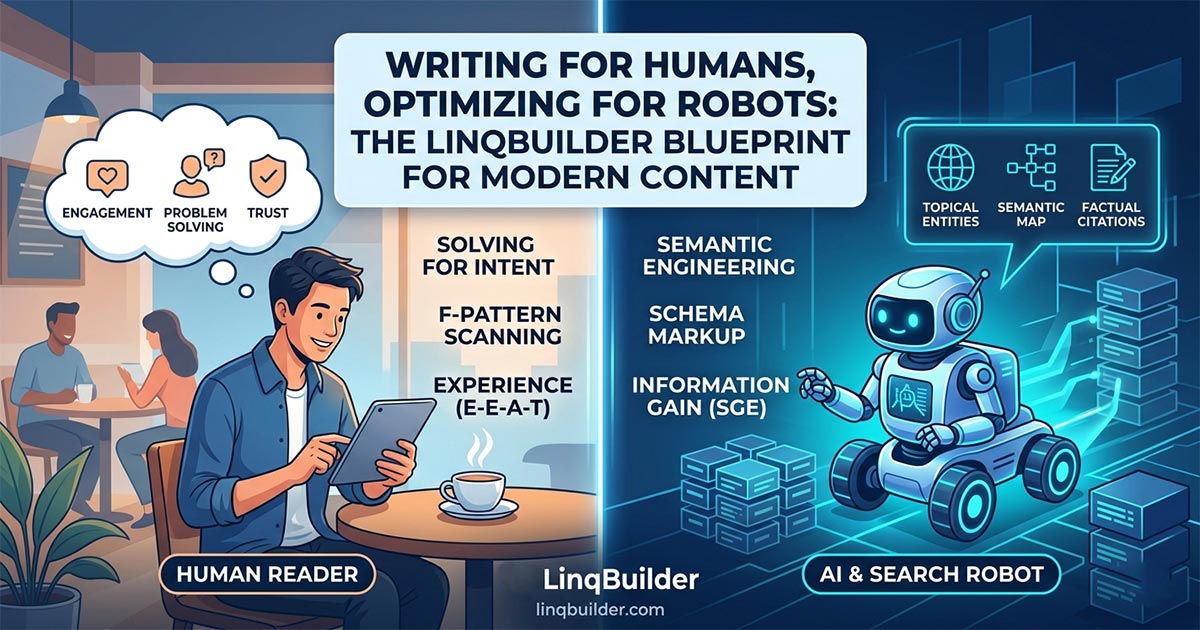
Writing for Humans, Optimizing for Robots: The LinqBuilder Blueprint for Modern Content
In the modern SEO landscape, we are often told to “just write for humans.” While that’s a noble sentiment, it’s only half the battle. If a human reads your post but a robot can’t find it, your content is invisible. Conversely, if a robot finds your post but a human finds it unreadable, your content is useless.
At LinqBuilder, we’ve developed a specific Content Blueprint that bridges this gap. It ensures your guest posts and blogs are high-converting for people and high-ranking for algorithms.
1. The Human Layer: Solving for Search Intent
Before we think about keywords, we think about intent. A human doesn’t search for “backlink services” because they want to read a dictionary definition; they search because they have a problem (stagnant rankings) and need a solution (authority building).
The Blueprint Rule: Every piece of content must answer a specific question within the first 200 words. We use the “Inverted Pyramid” style of journalism putting the most important information at the top to satisfy the human need for immediate value.
2. The Robot Layer: Semantic Engineering & Entities
Search engines like Google no longer just “match keywords.” They use Entities and LLMs (Large Language Models) to understand the topic of a page.
The Blueprint Rule: Instead of keyword stuffing, we focus on Semantic Completeness.
- If we are writing about “Link Building,” the “robots” expect to see related entities like Anchor Text, Domain Authority, Search Console, and Dofollow vs Nofollow.
- By including these LSI (Latent Semantic Indexing) terms, we provide a “topical map” that tells the algorithm exactly where our content belongs in the knowledge graph.
3. Structuring for Scannability (The F-Pattern)
Humans don’t read every word on a screen; they scan in an “F-Pattern.” Robots, on the other hand, use headers (H1, H2, H3) to understand the hierarchy of information.
The Blueprint Rule: * For Humans: Use bullet points, bold text for key phrases, and short paragraphs.
- For Robots: Wrap every main point in an H2 or H3 tag containing primary or secondary keywords. This creates a “Table of Contents” that Google can use to generate rich snippets.
4. Optimizing for the “AI Citation” Era
In 2026, we aren’t just optimizing for Google Search; we are optimizing for Search Generative Experience (SGE) and AI Overviews. AI models look for “quotable” facts and unique insights.
The Blueprint Rule: We include “Information Gain” nuggets original data, expert quotes, or unique analogies—that are easy for an AI to extract and cite. When an AI cites LinqBuilder content, it passes a massive trust signal back to the domain.
5. The Final Polish: The E-E-A-T Audit
Before any content leaves our desk, it undergoes a final audit for Experience, Expertise, Authoritativeness, and Trustworthiness.
- The Human Check: Does the tone sound like a helpful peer or a boring textbook?
- The Robot Check: Is the Schema Markup (FAQ, Article, Breadcrumb) correctly implemented to help the crawler index the page accurately?
Summary: The LinqBuilder Content Standard
Writing for the modern web is a balancing act. By following our blueprint, you don’t have to choose between a “viral” post and a “ranking” post. You get both.
Ready to upgrade your content strategy? Explore our SEO Content Writing Services.
FAQs’
Q: Is keyword density still important in 2026?
A: No. Exact keyword density is an outdated metric. Modern search engines focus on Topical Authority and Semantic Relevance. It’s better to cover a topic comprehensively with related terms than to repeat a single keyword multiple times.
Q: How do I write for AI search engines like SearchGPT?
A: AI models prioritize “originality” and “structure.” Use clear headings, provide direct answers to common questions, and include unique data or perspectives that aren’t found in other top-ranking articles.