


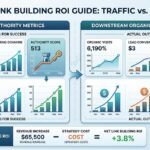

The digital sandbox has changed. If you are still buying link packages based on legacy metrics like arbitrary Domain Authority (DA) spikes, you are likely burning your marketing budget.
In 2026, the cost of a backlink isn’t just the upfront price tag you pay an agency or a freelancer – it is the long-term compounding value of that link minus its decay rate.
Here is why cheap backlinks cost drastically more in 2026, how the mechanics of link decay can quietly destroy your organic rankings, and what you should be doing instead to build lasting equity for your brand.
The Economics of Off-Page SEO in 2026
For years, the formula for off-page optimization felt straightforward: buy links in bulk, boost your overall domain metrics, and watch your target pages climb the Search Engine Results Pages (SERPs). But Google’s continuous integration of real-time spam filtering and neural network updates has shifted the core ranking weights.
Industry data indicates that traditional backlinks now account for approximately 45% of off-page ranking weight, while brand mentions, entity prominence, and contextual sentiment make up the remaining 55%.
2026 Off-Page Ranking Weights:
[███████████████░░░░░░░░░░░░░░░░░░░] 45% Backlinks
[████████████████████░░░░░░░░░░░░░░] 55% Brand Mentions & Entity Prominence
When search algorithms focus heavily on entity-first validation, a link is no longer a simple vote of confidence. It is a data pathway. If that pathway originates from a low-quality or manipulative source, the algorithm doesn’t just ignore it—it adjusts its trust profile for your entire domain.
What is Link Decay?
Link decay refers to the gradual degradation, loss, or devaluation of a website’s backlink profile over time. While natural link loss happens to every website, cheap backlink packages experience a hyper-accelerated form of decay that can actively pull down your organic performance.
The Two Faces of Link Decay
Mechanical Decay: This occurs when referring pages are completely deleted, redirected, or dropped due to site restructures or expired domain ownership.
Algorithmic Devaluation: The link technically remains live on the page, but Google’s systems have mapped, flagged, and discounted the referring domain. You are paying for a link that has effectively been rendered invisible.
When you purchase cheap links (such as $20 bulk packages or unvetted guest posts), you are investing in assets with a remarkably high decay rate.
Why Cheap Backlinks End Up Costing More
When budgets are tight, a lower price point per link seems highly attractive. However, the hidden operational costs of low-grade link building quickly surpass the cost of premium outreach.
1. The Hyper-Accelerated Decay Rate
Cheap links are typically placed on low-tier networks, unmoderated directories, or Private Blog Networks (PBNs). These sites have incredibly short lifespans.
When a cheap provider’s network goes down or gets swept by an algorithm update, dozens of your links vanish overnight. This sudden drop triggers a negative link velocity signal, indicating to search engines that your recent visibility boost was artificial.
2. The Toll on Your Crawl Budget
Modern SEO requires careful monitoring of how search engine bots navigate your site. When your profile is flooded with hundreds of low-quality, spam-heavy inbound links, search bots spend valuable crawl budget mapping those junk pathways instead of indexing your fresh cornerstone content or product pages.
3. The Price of Link Reclamation and Cleanups
Fixing a damaged backlink profile is far more expensive than building a clean one from the start. If your site is hit by algorithmic suppression due to toxic link patterns, you will have to spend thousands of dollars on deep backlink audits, manual link reclamation, or professional recovery services to get your rankings back to baseline.
The Core Differences: Cheap vs. High-Equity Link Building
To maximize your return on investment, it helps to understand exactly what separates a high-risk shortcut from a sustainable off-page strategy.
| Strategy Attribute | Low-Cost Link Packages ($20–$100) | High-Equity Manual Outreach ($300+) |
| Primary Sourcing | PBNs, automated link farms, or unmoderated guest post networks. | Earned editorial placements and strategic digital PR. |
| Domain Organic Traffic | Usually near zero or heavily declining, despite high artificial DA scores. | Steady, verified organic traffic from real human searchers. |
| Anchor Text Strategy | Over-optimized, repetitive exact-match anchors that create risk profiles. | Natural, balanced anchor distribution (mostly branded or semantic). |
| Average Half-Life | High decay rate; links often vanish or lose value within 3 to 6 months. | Low decay rate; placements routinely compound value over multiple years. |
A Sustainable Blueprint for Modern Link Building
If you want to protect your site from link decay and build long-term authority that AI-driven search models and traditional search engines trust, your strategy needs to evolve.
Move Toward Digital PR and Earned Media
The most resilient links are those that are earned naturally. By executing targeted digital PR campaigns, creating original data studies, or offering unique expert commentary, you secure editorial mentions on high-authority publications. Because these journalists make an independent editorial decision to cite your brand, these links carry zero structural risk.
Monitor Domain Health, Not Just Metrics
Before acquiring or pursuing a link insertion, look past standard third-party authority metrics. Check the site’s overall organic traffic trend using tools like Ahrefs or Semrush. If a site boasts a high authority score but receives zero organic search traffic from Google, its links are highly unlikely to pass meaningful equity to your pages.
Focus on Niche Relevancy and Semantic Alignment
A single link from a tightly aligned, mid-tier industry blog holds substantially more value than five links from generic “write-for-us” lifestyle portals. Ensure that the content surrounding your backlink is semantically rich and contextually relevant to your target page.
Build Equity That Compounds
In the current search ecosystem, cutting corners on off-page SEO is a high-risk strategy with diminishing returns. Cheap backlinks don’t just decay quickly—they drain your crawl budget, expose your brand to algorithmic volatility, and require expensive cleanup operations.
True affordability in SEO isn’t about finding the lowest cost per link; it’s about building a clean, highly relevant digital footprint that drives sustainable organic growth for years to come.