



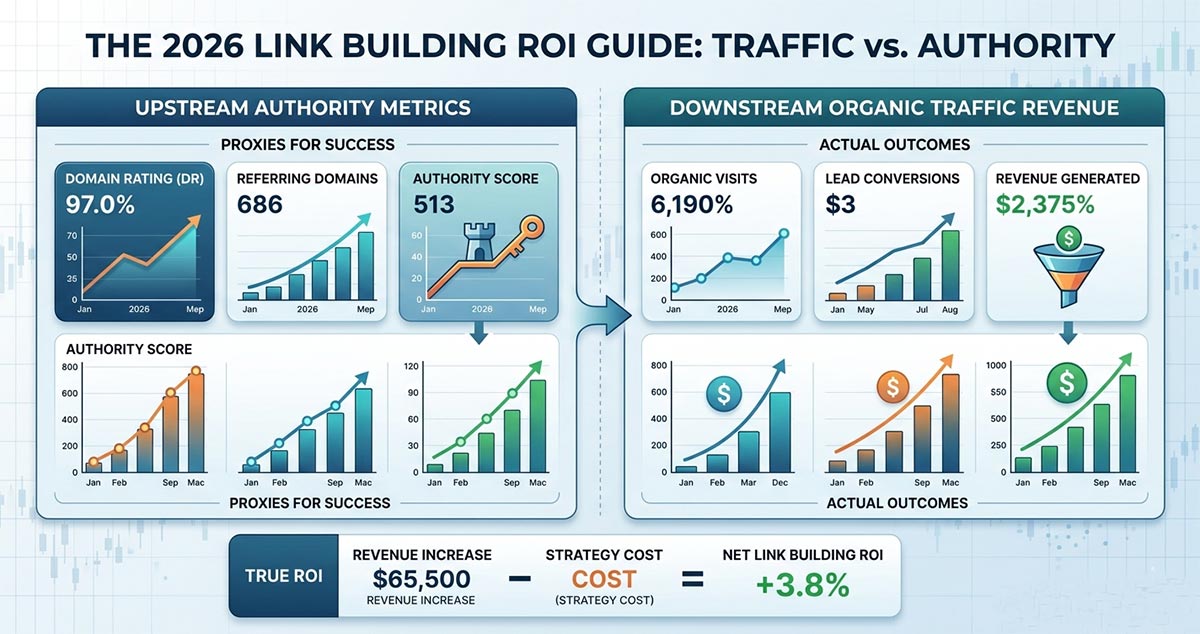
The landscape of off-page SEO has reached a critical inflection point. If your marketing team is still justifying their link building spend by showing a minor upward tick in a third-party metric like Domain Rating (DR) or Domain Authority (DA), you are missing the bigger picture.
In the current search ecosystem, an increase in authority metrics does not automatically guarantee a proportional lift in organic search traffic.
Calculating the true return on investment (ROI) of an off-page campaign requires measuring two distinct variables: the foundational shift in your domain’s trust architecture and the actual commercial pipeline generated by that visibility.
Here is how to calculate your true return on investment by analyzing traffic shifts versus authority changes.
The Strategic Conflict: Upstream Proxies vs. Downstream Revenue
The fundamental issue with typical off-page reporting is structural. Most digital agencies measure performance using upstream proxies—metrics that act as stand-ins for actual success.
Upstream Proxies (Predictive) ──>
Downstream Outcomes (Actual)
[ Domain Rating / Authority ]
[ Intent-Matched Traffic & Revenue ]
While third-party scores are helpful for competitive benchmarking and assessing link prospects, they are not ranking factors. Google’s neural networks evaluate links based on contextual relevance, source trust, and entities.
If your link profile expands via generic “write-for-us” networks or broad lifestyle portals, your tool metrics might climb, but your organic traffic will remain flat. This imbalance is driven by an intent mismatch—acquiring links that pass artificial authority without providing semantic value to your core target queries.
Building a 2026 Measurement Framework
To calculate accurate link building ROI, your measurement framework must separate your metrics into two core buckets: Authority Metrics (which indicate potential) and Traffic Performance (which prove actual execution).
Bucket 1: Authority Signals (The Foundation)
Velocity of Referring Domains: The consistent rate at which your domain earns new linking root domains. A sudden, inorganic spike followed by flat growth can indicate manipulative behavior to automated spam filters.
Semantic Entity Correlation: How closely search engines link your brand entity to your target industry keywords within their knowledge graphs.
Unlinked Brand Mentions: The natural volume of times your brand name appears across the web without a hyperlink, serving as a key brand prominence signal.
Bucket 2: Traffic Signals (The Revenue Engine)
Intent-Matched Organic Traffic Growth: Measuring traffic changes strictly on pages receiving targeted backlink support, filtering out irrelevant informational keywords.
Target Page SERP Position Velocity: The time it takes a targeted page to advance from second-page obscurity into high-CTR positions.
Direct Referral Conversions: High-quality placements on top-tier industry blogs or digital PR outlets often send real, pre-qualified human searchers down your funnel.
Evaluating the Matrix: Traffic vs. Authority Changes
When analyzing a campaign’s performance data after a 90-day window, your results will generally fall into one of four distinct categories. Understanding these scenarios helps you optimize your strategy:
| Traffic Trend | Authority Trend (DR/DA) | Operational Meaning | Strategic Correction |
| Increasing | Increasing | Perfect Campaign Health. Your earned links are topically relevant and carry real algorithmic weight. | Maintain your current strategy and scale outreach budgets into matching publisher categories. |
| Flat / Declining | Increasing | Metric Manipulation. You are likely acquiring links from sites with inflated authority metrics but no actual search presence. | Audit your prospects immediately. Switch your focus to sites with verified organic traffic trends. |
| Increasing | Flat | High-Relevance Micro-Links. You are earning links from small, hyper-niche industry sites that pass immense semantic value. | Double down on these sources. Trust contextual alignment over generic, high-metric domains. |
| Flat / Declining | Flat / Declining | Complete Structural Link Decay. Your links are either disappearing or being flagged and devalued by search filters. | Move away from automated networks and implement manual outreach standards. |
The Link Building ROI Formula
To calculate a precise financial return on your link building spend, look past broad marketing metrics and focus on your customer acquisition cost (CAC) and customer lifetime value (LTV).
Link Building ROI = Organic Revenue Growth – Campaign Outlay/Campaign OutlayX100
Where:
Organic Revenue Growth represents the net new revenue generated by target pages during the campaign window, minus their historical baseline performance.
Campaign Outlay equals the total cost of your strategy, including content creation, digital PR fees, and manual outreach tools.
Because high-equity links compound in value over time, a clean profile lowers your long-term cost per click (CPC) compared to paid channels.
Actionable Strategy for Higher Returns
If you want to maximize your organic growth and ensure every acquired backlink moves your traffic metrics, refine your process around three core pillars:
1. Enforce Strict Publisher Qualifications
Stop evaluating link prospects solely by their third-party authority score. A domain must pass three strict criteria before you spend time or budget on outreach:
It must have a stable, verifiable organic traffic trend.
It must be topically relevant to your niche.
It must feature clear, human editorial standards with no public link-selling footprints.
2. Prioritize Digital PR and Original Data Assets
The most resilient backlinks are those that cannot be easily replicated by a competitor. By publishing original research, proprietary data studies, or unique interactive tools, you create linkable assets that journalists and industry blogs will naturally cite.
3. Maintain Balanced Anchor Text Distributions
Avoid over-optimizing your profile with repetitive, exact-match keyword anchors. Modern search engine algorithms rely on advanced natural language processing to read the surrounding text context. Keep your anchor distribution natural by prioritizing branded terms, transparent article titles, and descriptive phrases.
Focus on Growth That Lasts
Authority metrics are useful guideposts, but they are not the end goal. A successful link building campaign should ultimately build lasting brand equity, protect your site against link decay, and drive intent-matched organic traffic directly to your high-value pages.
By matching your authority building efforts with strict contextual relevance, you ensure your off-page budget drives measurable, bottom-line results.